
Environment committee draft reconciles EPA input on CAFO permitting; debate centers on agency authority and technical language
Get AI-powered insights, summaries, and transcripts
Subscribe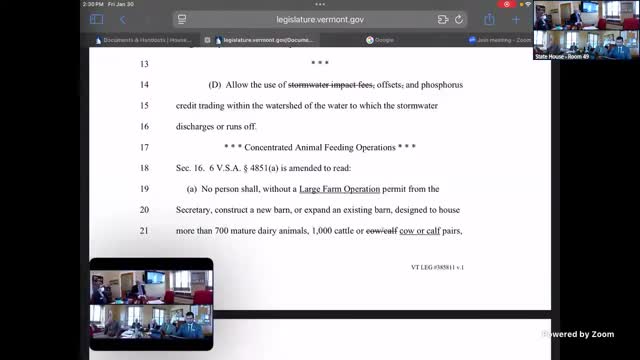
Summary
Committee reviewed proposed amendments to concentrated animal feeding operation (CAFO) law introduced to incorporate EPA comments, clarify agency authority between ANR and Agency of Agriculture, adjust numeric thresholds and wording (e.g., replacing a virgul), and delay the CAFO general permit timeline to 2027.
An extended technical review of H.632 and related CAFO language focused on reconciling federal Environmental Protection Agency input with Vermont's state permitting structure and agency authorities. An unidentified speaker (S8) briefed the committee that EPA had provided language the state needed to incorporate and that several technical edits and a few substantive clarifications were being proposed.
"Unbeknownst to you all and to me as well, apparently, EPA provided some input on the language last year, and it didn't make it into your bill last year. And this is being offered to reconcile what EPA requested," the speaker said, summarizing why changes were needed. Key points the committee discussed included which agency has permitting authority for discharges (the Agency of Natural Resources for NPDES permits), whether language granting the secretary discretion to require a CAFO permit should remain, and a now-agreed plan to remove or reword problematic language the Agency of Agriculture had requested be deleted.
S8 said the CAFO general permit that the statute required by Dec. 15, 2025, has not been issued; House Environment is leaving the implementation date at Sept. 1, 2027, to allow more stakeholder work. The briefing highlighted that ANR already has authority under federal-aligned rules to designate an animal feeding operation as a CAFO if it is a significant contributor of pollutants to waters of the United States or state waters.
The committee also discussed several technical changes: replacing a punctuation construct (a "virgul") with explicit wording ("and" or "or") to avoid ambiguous statutory interpretation; embedding federal numeric thresholds (large/medium/small CAFO definitions) directly in state statute rather than cross-referencing federal definitions; and removing the prior memorandum of understanding (MOU) reference between agencies at EPA's request while requiring a documented process for interagency implementation.
Members queried thresholds used in the definitions; one example cited in the review was that for dairy, a 'large' CAFO threshold is 700 animals. Speakers flagged overlapping jurisdiction questions where stormwater-only discharges, intermittent discharges, and mixed process wastewater may trigger different permitting paths. S8 noted the bill includes an emergency rulemaking authority if federal program changes materially affect state implementation.
S8 said a redraft removing the contested language would be ready for the House Environment Committee the following Tuesday afternoon and that the chair downstairs would likely appreciate the cleanup. The committee did not vote on the bill during this session; members were invited to participate in stakeholder meetings and follow-up testimony.