Get Full Government Meeting Transcripts, Videos, & Alerts Forever!
Get email alerts on the Housing Funding Cuts topic
No spam. Unsubscribe anytime.
Contra Costa housing staff warn HUD funding changes could cost hundreds of vouchers
Summary
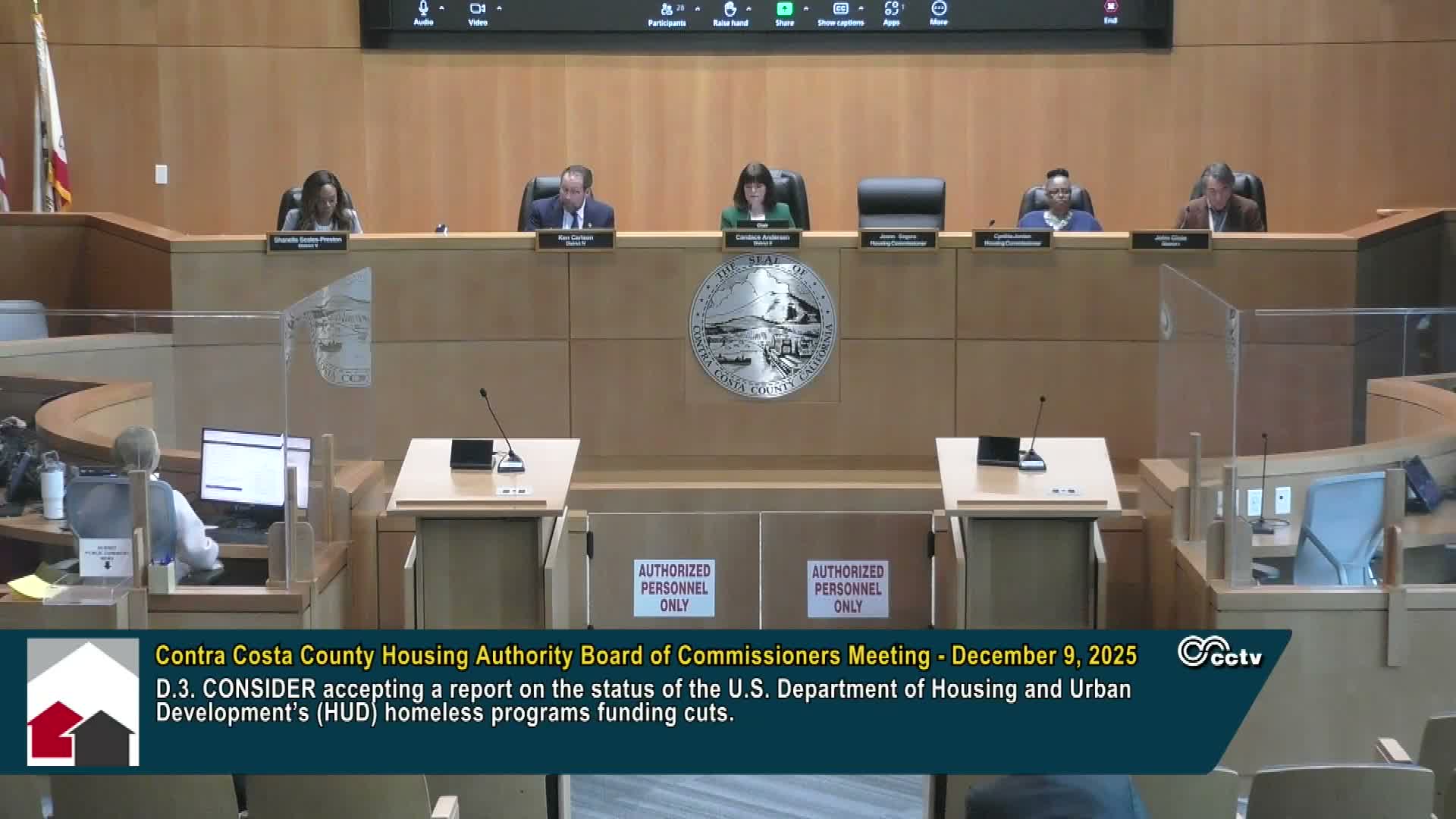
Housing Authority staff told commissioners that recent HUD changes and a pulled Continuum of Care NOFO could eliminate roughly 550 vouchers and millions in supportive-services funding, and urged the county to consider short-term transition assistance. Staff described specific program expirations and proposed a plan to convert units to Housing Choice Vouchers where possible.
Housing Authority staff told commissioners that sudden changes to federal housing funding could remove hundreds of local housing subsidies and prompt rapid transitions for vulnerable households. Joseph, a housing authority presenter, said HUD had pulled or revised a Continuum of Care Notice of Funding Opportunity and that the immediate effect could be the loss of approximately 550 units across programs.
The briefing laid out the most acutely affected programs and the Authority’s contingency plans. Joseph said the Shelter Plus Care tenant‑based rental assistance (TBRA) program could house up to 273 units on about $8,000,000 annually and that the Shelter Plus Care project‑based rental assistance (PBRA) supports 15 units on roughly $434,610. “We know for a fact that we're losing 550 units out of all of our programs,” Joseph said, warning that some cuts could be large and sudden and that HUD guidance remains incomplete.
The Authority also described Emergency Housing Vouchers (EHV) established under the American Rescue Plan, noting 180 households locally on the program and incoming portable EHVs from other housing authorities. Joseph said the Authority is tracking incoming vouchers from 11 PHAs, including 49 from the San Francisco Housing Authority that are projected to expire Sept. 30, 2026. He added that some EHVs around the region may run out earlier in 2026, and that local EHV funding could deplete before December depending on expenditures.
Household data presented by staff underscored the population at risk: Joseph said 100% of households in the programs include at least one person with a disability and that average annual incomes reported for EHV and Shelter Plus Care households are in the low‑teens of thousands of dollars. He also highlighted the Authority’s reserve volatility — reserves fell from about $1,900,000 to $421,000 in one month — and that HUD recaptured roughly $7,000,000 from the Authority earlier in the year, reducing the Authority’s ability to float transitional costs.
Joseph described a transition strategy that would move affected households to Housing Choice Vouchers or project‑based vouchers when possible and convert some PBRA and EHV support to longer‑term voucher solutions. He said the Authority had been preparing a potential request to the county for short‑term transition funding — previously estimated at $1,500,000 to cover roughly 40% of Shelter Plus Care TBRA funding for five months — but that the ask and timing remained uncertain pending HUD’s decisions. “We're looking for transition help, not an ongoing subsidy,” Joseph said.
To speed transitions, Joseph said HUD issued a waiver allowing the Authority to bypass some usual wait‑list public‑notice and hearing steps that typically slow transfers between programs. Staff said they would provide the board with the supplemental PowerPoint and continued updates; commissioners asked for follow‑up at the next board meeting to decide whether to allocate any county funds.
The Housing Authority said it will continue outreach to PHAs with incoming portable vouchers and coordinate with partners including Hope Solutions, the county Department of Conservation and Development, RCD, and other nonprofit owners and service providers. The board received the report and will be updated as HUD issues further guidance.