
Division of Fire Safety urges caution on quick adoption of International Residential Code in H.718
Get AI-powered insights, summaries, and transcripts
Subscribe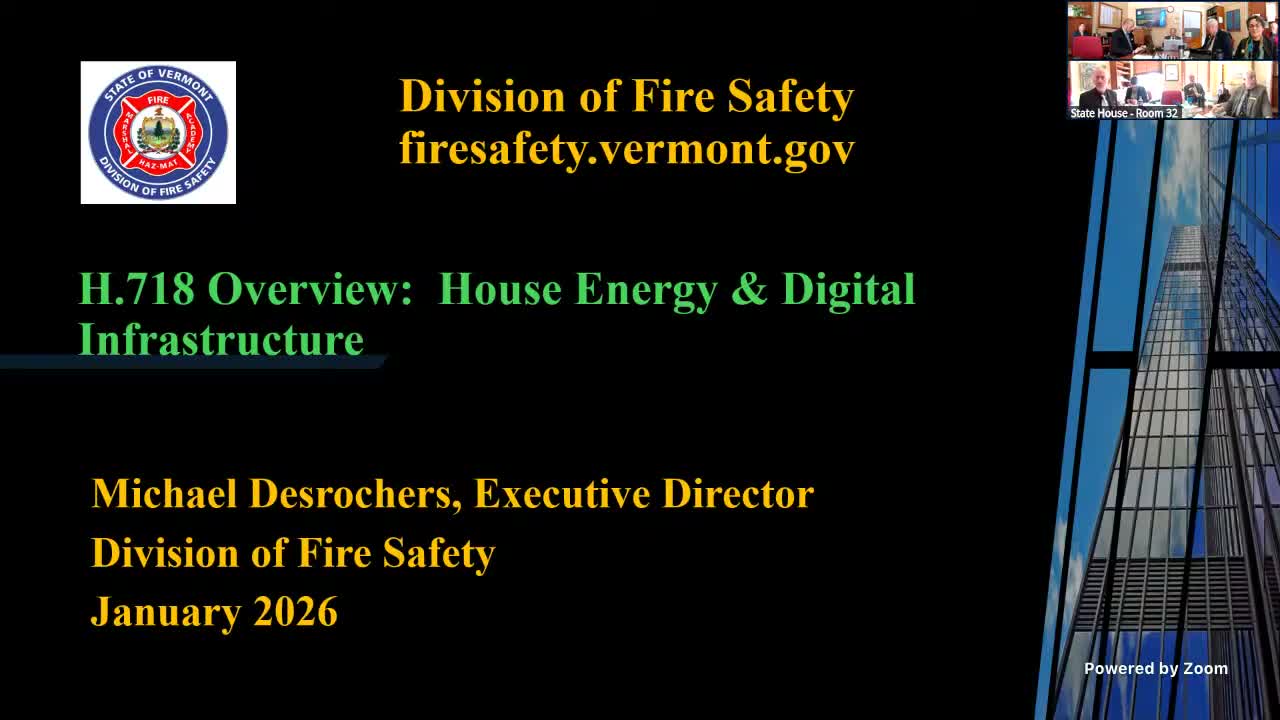
Summary
The Division of Fire Safety told the House committee it opposes a statutory deadline to adopt the International Residential Code (IRC) by Jan. 1, 2028, citing technical conflicts with existing state standards, sprinkler and design-professional requirements, and implementation burdens for trade licensing and records systems.
Mike Narosha, executive director of the Vermont Division of Fire Safety, told the House Energy and Digital Infrastructure Committee that the division opposes the bill provision requiring adoption of the International Residential Code by Jan. 1, 2028. "The division strongly opposes the adoption of the International Residential Code by 01/01/2028," Narosha said, arguing the agency needs more time to assess conflicts with existing rules and the practical impacts on permitting and business flows.
Narosha clarified the department already enforces the International Building Code for residential construction of three or more units, and that the bill’s finding that Vermont "has not adopted a residential building construction code" narrows to a gap for one- and two-family dwellings. "The division does adopt the International Building Code for residential construction," he said, noting the IRC covers single- and two-family homes and would expand DFS responsibilities if adopted without detailed amendments.
Committee members asked about specific consequences. Narosha highlighted two technical hurdles: IRC references and equivalencies to NFPA standards that would need reconciliation, and the IRC’s residential sprinkler language. "The IRC requires sprinklers of one- and two-family dwellings," he said, adding that the IRC also generally requires plans to be submitted by a design professional — a change that would touch current practice for small residential projects.
On funding and training, Narosha said the bill’s grant language could be useful but is not necessary for DFS to study the code change. He described a previously awarded BRIC grant that the division budgeted for training and record-management upgrades — "We did receive a BRIC grant of $1,400,000," he said — and told the committee that the award was later rescinded and is the subject of litigation. Narosha said those funds, if restored, would have supported training for inspectors and contractors to improve compliance with any new standards.
The committee also questioned a provision in H.718 tying an updated energy-efficiency education module to license renewal. Narosha said the statewide module created under 2020 law was embedded into many trade continuing-education classes to avoid disrupting renewals and reciprocity; he called the existing module "outdated" and supported redesigning it, but warned that making it a licensing requirement or increasing mandated continuing-education hours would be a significant administrative burden for thousands of trade professionals.
Narosha offered a compromise: allow DFS and stakeholders flexibility to redesign and update the energy-efficiency module and its delivery method so it can be folded into existing continuing-education processes rather than force a wholesale change to licensing or create new tracking burdens in the agency’s records management system.
The committee did not take formal action on H.718 during the session. Members signaled interest in working with DFS on clarified language, potential carve-outs (for example, excluding boiler inspectors from the module requirement), and a realistic implementation timeline before considering a statutory adoption deadline.