Get Full Government Meeting Transcripts, Videos, & Alerts Forever!
Get email alerts on the Sewer Extension Policy topic
No spam. Unsubscribe anytime.
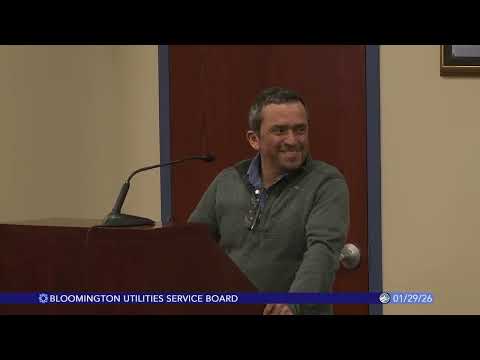
Bloomington Utilities board adopts rule to allow limited sewer extensions for strategic economic sites
Summary
The City of Bloomington Utilities Board voted Jan. 29 to adopt an amendment to Section 24.2 of its rules allowing the director, with council ratification, to extend sanitary sewer service outside city boundaries for developments identified as strategic economic development sites under Indiana Code 36-4-3-21. Board members emphasized limits: the tool targets new projects, requires engineering review and council ratification, and does not automatically apply to existing businesses.
The City of Bloomington Utilities Board on Jan. 29 adopted changes to Section 24.2 of its rules and regulations to permit limited sanitary sewer service extensions outside municipal boundaries for developments designated as strategic economic development sites.
Board Chair (Unidentified) moved to adopt the changes after staff presented three draft versions (current text, a marked-up redline and a clean copy). The revised paragraph read aloud during the meeting states that “the director may grant a request for extension of sanitary sewer service to parcels located outside of the city's municipal boundaries through agreement and council ratification under Indiana Code 36-4-3-21” when the development has been identified by the City of Bloomington Department of Economic Development as a strategic economic development site.
Why it matters: staff and board members said the amendment creates a limited, flexible tool to serve large economic projects that can generate jobs and payroll growth without requiring annexation. Staff said the tool is intended to target new, large-scale projects and will not relieve the board from engineering feasibility checks, capacity constraints or the need for a sewer-main-extension agreement and council ratification before service begins.
During discussion, board members pressed staff on scope and safeguards. One board member warned the approach could "punish existing businesses," saying the policy might disadvantage firms already outside city limits; another board member and staff rejected that characterization and described the provision as a response to state annexation law and as narrowly focused on new opportunities. Staff also said it had consulted outside counsel and that counsel recommended the approach as a flexible tool amid ongoing litigation over annexation.
Board Chair (Unidentified) and members noted statutory limits such as contiguity rules for voluntary annexation and said the policy does not automatically expand other city services. When asked whether the change would allow extensions for services beyond sanitary sewer, staff replied the change is specific to sanitary sewer only.
The board approved the amendment by voice vote. Board members and staff said they can refine the language if the board prefers a clearer, explicit statement limiting the tool to new economic development projects when the item returns for finalization or future review.
What’s next: the amended rule will be used as a procedural tool when the Department of Economic Development identifies qualifying, strategic sites and when the city determines engineering feasibility, capacity and appropriate contractual safeguards are in place.