
House committee advances bill to allow battery storage at existing solar sites
Get AI-powered insights, summaries, and transcripts
Sign Up Free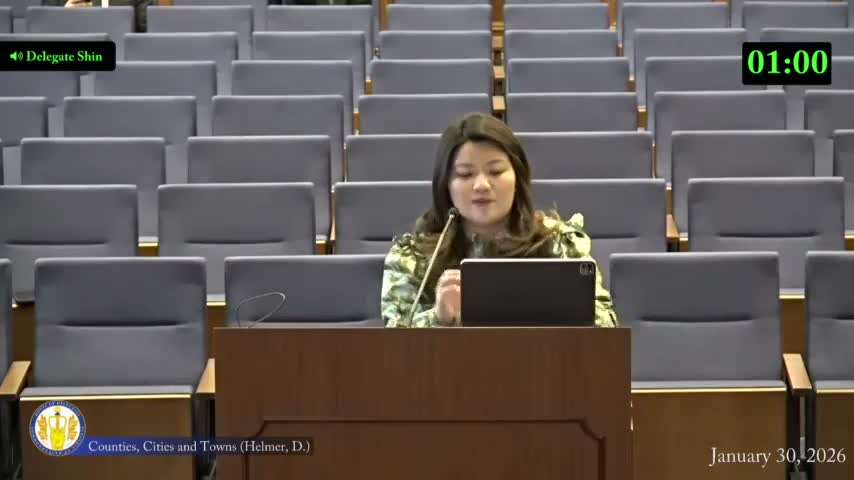
Summary
The House Committee on Counties, Cities and Towns voted to report House Bill 891 after hearing supporters who said adding battery storage to permitted solar sites would boost reliability and opponents who warned it would curtail local land‑use control and revenue mechanisms.
House members on the Committee on Counties, Cities and Towns voted 17–2–4 to report House Bill 8 91 after a brief, time‑limited hearing in which proponents portrayed the measure as a narrow land‑use change that would improve grid reliability and opponents said it would erode local control.
The bill’s sponsor described HB 891 as a measure to “add battery energy storage systems to existing solar energy facilities,” saying storage lets the Commonwealth “bank energy produced in the state during the lowest cost hours and deploy that energy during the highest cost hours.” The patron emphasized the change addresses short‑term reliability concerns and affects only land‑use determinations, leaving building permits, fire safety and environmental regulations in place.
Philip Scribe, testifying for AES, called the approach “very limited” and said it allows developers to add capacity at sites that already have permits without disturbing new farmland or forests. “This only affects projects where they are locating on an existing solar site,” Scribe said, adding the bill “preserves all of the building permit processes” and does not apply to stand‑alone storage projects.
Environmental and renewable‑energy stakeholders offered support: Josepha Salman of the Southern Environmental Law Center said the bill “will increase the effectiveness of our existing solar facilities,” and Jeff Palmore of the Mid Atlantic Renewable Energy Coalition said it would improve energy reliability in Virginia.
Opposition testimony came from Joe Lurch of the Virginia Association of Counties, who warned the bill would remove local decision‑making authority over siting and diminish locally negotiated host agreements. “What they see from their point of view… it is taking away that local decision‑making authority from that elected board and their constituents,” Lurch said, and he noted the state’s mandatory machinery‑and‑tools tax exemption he said reduces local revenue streams tied to these projects.
Committee members pressed for technical clarifications. Counsel and industry witnesses confirmed that, under the bill as drafted, battery storage must be sited on the land parcel for which the solar project already received local approval and that existing permitting, setback and buffering requirements remain applicable. Counsel clarified for a member that data centers are not by‑right uses under the bill’s language.
After questions and a short exchange about whether the bill removes the host‑community agreement option, a motion to report the bill carried on the roll vote. The committee’s vote to report HB 8 91 will advance it in the legislative process; the measure will next appear on the committee’s calendar for floor consideration or further committee action as scheduled.