Get Full Government Meeting Transcripts, Videos, & Alerts Forever!
Get email alerts on the Budget topic
No spam. Unsubscribe anytime.
School board hears midyear budget trends; approves minutes and adjourns
Summary
At a regular meeting, the school board reviewed a midyear financial report from Lynn Braga covering revenue timing, personnel and object-code spending, CIP balances and transfer procedures; the board approved previous minutes by roll call and adjourned without entering closed session.
Speaker 1 called the meeting to order and, after a roll call confirmed a quorum, the board approved the previous meeting’s minutes by voice and roll-call vote. A motion to approve the minutes was moved by Speaker 3 and seconded by Speaker 4; five members voted yes, one member (Jafari) was absent.
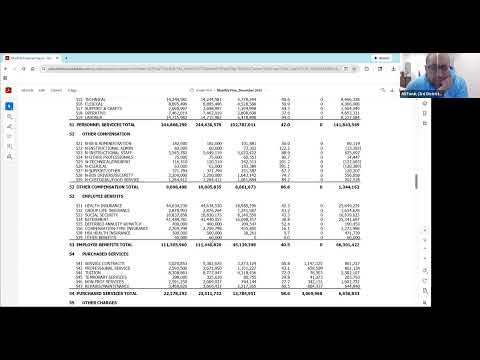
Lynn Braga, who led the budget presentation, summarized the district’s midyear financial position. Braga said the district is about 50% through the fiscal year and had received roughly 45% of its resources so far. She explained timing differences among revenue sources: city appropriations are posted quarterly (the December report reflected only first-quarter city funding), state funds arrive twice monthly, and relatively little federal revenue flows through the general fund aside from specific program support such as JROTC.
On spending, Braga said most personnel and contracted services are tracking near 50% year to date. She noted lags in certain teaching and transportation lines—particularly instructional class staff and bus drivers/monitors—because their contracts begin in August. Braga identified an hourly/substitute line that is overspent year to date by about $120,000 and explained that vacancy coverage shifts costs into hourly lines rather than indicating an overall deficit.
Braga reviewed purchase-services and other object-code items. She said tuition payments to partners (named in the presentation as Maggie Walker, Appomattox and CodeRVA) are often paid up front and therefore show higher spending early in the year. She flagged a low balance in the HSA line and offered to check on it.
On capital funds and the CIP, Braga reported Fund 435 (ADA compliance) has approximately $2,500,000 available. She said Fund 461, which captures recurring city maintenance appropriations, had a reported balance of about $12,000,000 but much of that remains unencumbered pending procurement and RFP processes. Fund 470, which tracks the city’s initial $200,000,000 allocation for Richmond High School for the Arts, showed roughly $42,600,000 remaining on the ledger with additional expenditures expected as the project nears opening. Braga also said a previous Arthur Ashe Center rental revenue line should be removed from the books because the center is no longer a viable revenue source; she noted a small residual Bon Secours cash balance that will be used for athletics.
Braga characterized the school nutrition program as roughly a $22,000,000 effort funded predominantly by federal dollars, with a small local contribution and a minor carryover from art funds being cleaned up.
Board members asked procedural questions about transferring funds between object codes. Braga explained that budget holders submit transfer forms; transfers under $10,000 are processed administratively and are shared with the board, while transfers above $10,000 require board approval and will appear on subsequent financial reports. When asked about central-office staffing, Braga described the district’s budget structure in 10 areas: Areas 1–2 are school-based staff; Area 3 includes the school board office and internal audit; Area 4 includes the superintendent’s area, budget and finance, and grants; Area 5 covers non-school-based instructional support; other areas cover wellness, talent and related functions. She said she did not believe the district had added a large number of central-office positions in recent years and noted recent hires that focused on instructional needs (for example, multilingual learner teachers).
The agenda included a planned closed session to discuss the auditor position, but Speaker 1 said there were no updates and the board elected not to go into closed session. Speaker 1 adjourned the meeting after thanking attendees.
Next steps: Braga offered to provide follow-up detail on the HSA line and a historical breakdown of central-office staffing if the board requests it; transfers above the $10,000 threshold will be brought to the board for formal approval and will appear on future financial reports.