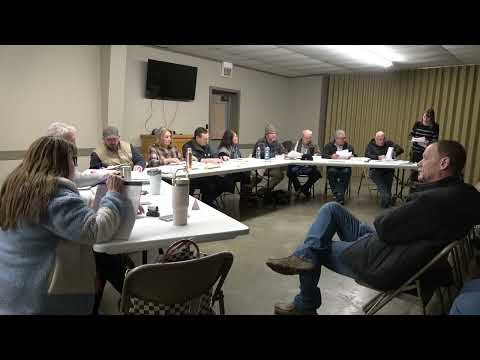
Planning commission backs major wind‑energy zoning changes, including 500‑foot cap and new setbacks
Loading...
Summary
After hours of mapping, staff presentations and nearly two hours of public comment, the Marion County Planning Commission voted 9–1 to recommend revisions to Article 27 that cap turbine tip heights at 500 feet, establish new setback distances (including 3‑mile buffers for cities and a 5‑mile protection for registered airfields), and add participation/consent language for nonparticipating landowners.
The Marion County Planning Commission on Jan. 26 voted 9–1 to recommend substantive changes to Article 27, the county’s wind‑energy zoning chapter, after extended staff presentations and a lengthy public‑comment period that drew residents, municipal officials and landowners. The commission’s recommendation includes a local cap on turbine tip height, a revised matrix of setbacks by receptor type, and a clarification allowing a nonparticipating property owner to become “participating” if they provide written consent to a developer.
Staff presented GIS maps showing how cumulative setback overlays reduce developable acreage and explained assumptions used in the maps (standard 60‑ft section‑line right‑of‑way, parcel data, and National Wetlands Inventory layers). Commissioners debated two approaches: fixed large distances for some receptors (for example, a three‑mile buffer from incorporated city limits and airports) and height‑based protections for roads and residential structures (tower height plus a fixed buffer). Staff and several commissioners emphasized that both safety (evacuation / ice‑throw / blade‑fail risk) and land‑use rights must be balanced.
Key agreed elements the commission captured in a motion to recommend to the Board of County Commissioners: a local turbine tip‑height cap of 500 ft (tip‑to‑base); a quarter‑mile (0.25 mile) setback from state and federal highways; a 550‑ft setback (tower height plus 50 ft example) from participating residential structures; a 2,640‑ft setback from nonparticipating residential structures (discussion referenced evacuation guidance of roughly 1,640 ft and then moved to larger buffers during debate); wetlands protections using a 1,320‑ft buffer or site‑specific delineation and mitigation; a three‑mile (15,840 ft) buffer from incorporated city limits (and airports/airstrips generally) with an explicit 5‑mile buffer adopted for registered airfields/airstrips by majority vote; and schools, churches and public water supplies captured in a 2,640‑ft buffer in the proposed table. The commission also agreed to insert a sentence that a nonparticipating property owner who gives written consent to a WEX (wind energy) developer shall be treated as participating for setback calculations.
Public comment was extensive. Residents raised safety concerns including ice‑throw, blade fragmentation, turbine fires and long‑term cleanup liabilities; several speakers said turbines have reduced property values where they exist. Evan Yoder urged the commission to approve the draft and wrote that "Marion County has 2 wind farms. Enough is enough." Linda Peters recounted debris from a damaged turbine in another county and warned of cleanup and environmental contamination. Municipal leadership weighed in: Evan Esau, identified as mayor of Gossel, asked for a 5‑mile protection for municipal wells and public‑safety concerns; the commission discussed tying public‑water protections to KDHE mapping and standards.
After members summarized the edits they had agreed to during the meeting, a motion to recommend the revised Article 27 to the Board of County Commissioners passed by roll call 9–1. Staff announced a 14‑day protest period; the earliest County Commission meeting availability noted was Feb. 17. The commission emphasized that this vote was a recommendation and that the county commission will consider testimony, protests and final ordinance language before any regulation takes effect.