
Department of Health details grant shifts, appropriation transfers and a net staffing decline in FY27 plan
Get AI-powered insights, summaries, and transcripts
Subscribe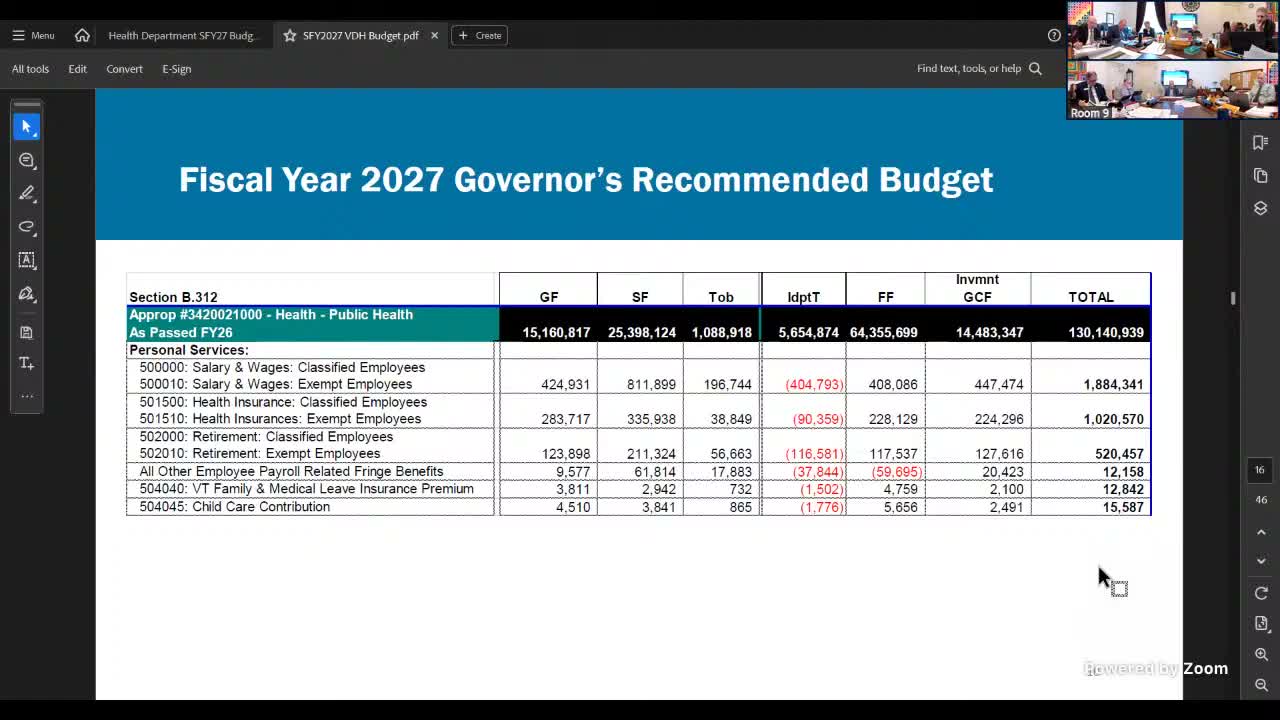
Summary
Financial Director Megan Polk told the committee the department plans several internal transfers (Narcan program to Substance Use appropriation, school Medicaid claiming to Agency of Education/DEVA, preschool-development duties to DCF), expects continued federal grants and noted a net reduction of 16 positions with a 3% vacancy-savings rate in the budget despite an actual ~8% vacancy; the committee also discussed single-audit findings and the upcoming joint fiscal committee review of the Rural Health Transformation grant.
At the House Appropriations Committee hearing, Financial Director Megan Polk walked members through appropriation-level changes and grant treatment in the FY27 request.
Polk said several programs will move between appropriations to reflect where work is housed and how spending authority is used: the medical and lab supply line that covers the Narcan program is moving from the Public Health appropriation to the Substance Use appropriation (to be paid from the evidence-based education special fund), the school Medicaid assistance claiming process will be managed by the Agency of Education (DEVA) and some preschool-development grant work will move to the Department for Children and Families.
Polk said the syringe service program will be shown in the Substance Use appropriation grants rather than public health, and stressed these moves are intended to align funding sources and account codes with actual program operations.
On staffing, Polk said the department has a net reduction of 16 positions compared with FY26 (driven by the end of limited-service COVID-era grants and some reassignments) and that the budget maintains a 3% vacancy-savings assumption while the actual vacancy rate across the department is about 8%. Committee members asked whether the department is having hiring difficulty; Commissioner Hildebrand said recruiting for public health is a long-term concern and described steps to build pipelines with UVM and internship programs.
Polk summarized single-audit results: two compliance findings tied to one program in the 2024 audit and corrective action plans implemented; she said neither finding rose to the level of a material weakness. Committee members asked for details on the nature of the findings and Polk described one as an FFATA compliance issue and the other as missing program documentation, both since corrected.
Committee members also discussed the Rural Health Transformation Program (RHTP) grant; the Committee Chair said the Joint Fiscal Committee must publicly accept the grant at its next meeting and warned the legislature cannot reappropriate or change the grant terms. The Chair noted acceptance would result in what he described on the record as "$195,000,000 a year for 5 years," and said the Joint Fiscal Committee could decline acceptance if members chose to do so.
Next steps: Polk offered to provide additional detail on subgrants (the department administers roughly 450 subrecipient grants) and to follow up on audit and staffing questions; the committee scheduled further deliberations.