Tualatin planners weigh how to align local rules with stateclear-and-objective housing law
Loading...
Summary
City consultants presented a code audit and options to bring Tualatindevelopment rules into compliance with the stateclear-and-objective housing standard. Commissioners generally supported creating an administrative "adjustment" path for multifamily but were divided over allowing multifamily in low-density RL zones; no formal votes were taken.
Tualatin planning commissioners received a presentation from city consultants on proposals to update the citydevelopment code to comply with the stateclear-and-objective housing standard (referenced in the meeting as ORS 197a.400). Consultant Kate Rogers said the audit identified numerous code sections that use discretionary or vague terms and recommended a mix of numeric standards, purpose statements and, where appropriate, a new administrative adjustment process to reduce discretionary review.
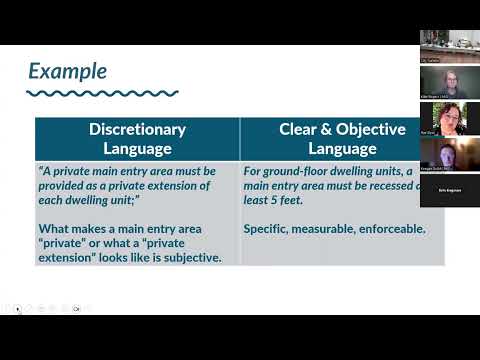
"The statute requires local governments to have clear and objective standards, conditions, and procedures for housing development," Kate Rogers said, explaining the project is funded by a grant from the Department of Land Conservation and Development and will produce draft code amendments for commission review in the spring. Rogers and the consultant team illustrated how adding measurable metrics (for example, defining a recessed entry as at least five feet) can convert subjective design language into objective standards.
Commission discussion centered on three policy questions posed by the consultants: whether to keep Tualatin two-track system (parallel objective standards and discretionary guidelines) or move to a single objective track with an administrativeadjustment/modification option; how to treat multifamily design standards; and whether to allow certain multifamily and retirement housing by right in RL (low-density residential) zones or to prohibit it and require rezoning.
On the first two questions commissioners broadly favored creating an administrative adjustment or modification procedure that would operate as a staff-level (type 2) review with notice to nearby property owners. Several commissioners argued that most applicants already follow the clear-and-objective path and that an adjustment process would be a faster, more predictable way for projects to request limited deviations than a full discretionary hearing. Staff cautioned that drafting a new adjustment procedure and adding purpose statements could exceed the current grant scope and that full implementation may require additional funding or a phased approach; staff also noted the project contract and grant funding extend into 2027.
The third policy question produced the most disagreement. Consultants described option variants that would allow limited, lower-intensity multifamily and senior housing by right in RL (for example, matching densities to nearby RML standards such as roughly 10 units per acre and 15 units per acre for certain retirement housing) while preserving conditional use review for larger or higher-intensity proposals. Other commissioners argued the city should instead remove multifamily allowances from RL and make any higher-density housing subject to a rezoning process that would require public notice and community input (and avoid what some described as a stealth increase in density without clear public engagement).
Commissioners repeatedly emphasized two practical considerations: (1) Measure 56 notice requirements apply when an allowance is removed from a zone (the consultants flagged the need to provide that statutory notice if multifamily were prohibited in RL), and (2) certain development forms can achieve much higher densities under other rules (the consultants and commissioners cited recent development patterns and examples when discussing what would be financially feasible to build).
No formal vote or ordinance was adopted at the meeting. Instead, the commission gave staff and the consultants direction to prioritize development of an adjustment/modification procedure focused on multifamily housing and to return with draft code language and additional stakeholder outreach. Staff said it would incorporate the commissionfeedback, meet with city council, conduct focus-group outreach with developers and stakeholders, and bring draft amendments back for review in the spring. The consultants also noted the city will be conducting a housing production and capacity analysis and will coordinate the work with the stateOregon housing needs process.
Other business: staff noted an upcoming code amendment on backyard domestic fowl (adding ducks to the list of allowed animals) that will be brought to a future meeting.
The meeting concluded without votes on the policy questions; commissioners moved to adjourn.