
VHCB tells lawmakers Vermont is losing farmland faster than projected; conservation easements, development-rights purchases cited as tools
Get AI-powered insights, summaries, and transcripts
Sign Up Free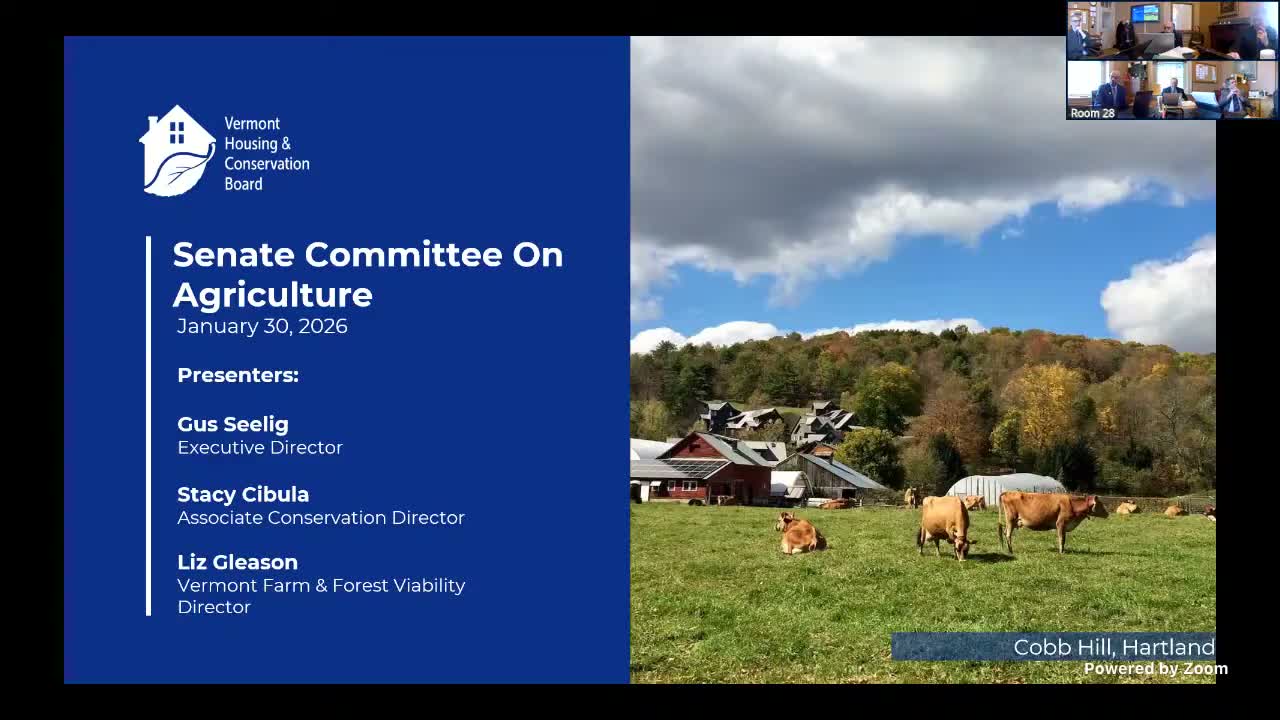
Summary
Vermont Housing and Conservation Board staff told a legislative committee Jan. 30 that modeling projects a loss of 41,200 acres of farmland by 2040 and that the state is losing land faster than expected; presenters highlighted conservation easements, development-rights sales and farm-transfer support as tools to keep land in agriculture.
Gus Sealy, executive director of the Vermont Housing and Conservation Board, told a legislative committee on Jan. 30 that the agency’s conservation programs are aimed at keeping farmland in agricultural use and supporting farm transfers.
Stacy Sicilio, VHCB’s associate director of conservation, cited a 2022 American Farmland Trust analysis that projects Vermont could lose 41,200 acres of farmland by 2040 and said ‘‘we’ve already lost nearly half of that amount’’ and that loss is occurring ‘‘65% faster’’ than the model originally predicted. She estimated the modeled loss translates on the ground to roughly 2,000 farms and about 700 jobs.
Sicilio described VHCB’s farmland-conservation work as centered on acquisition of development rights (conservation easements), which she said ‘‘is reducing the value on average about 60%’’ and often makes land affordable for transfer to beginning or next‑generation farmers. The agency and partners such as the Vermont Land Trust and Upper Valley Land Trust use easements and other tools to enable farm transfers, finance business investments and preserve ecological values such as stream buffers and wetlands.
Speakers identified low-density residential development as the primary near-term threat to productive acreage, pointing to houses placed along field edges, septic siting and minimum-lot-size planning as common drivers. Committee members also noted commercial development corridors and solar projects as additional pressures in some locations.
VHCB staff highlighted farm- and forest‑viability supports that provide one-on-one technical assistance and business planning; Liz Leeson, VHCB’s farm and forest viability program director, said VHCB worked in-depth with about 110 businesses last year and that more than 70% of clients increased sales, with an average sales increase of roughly $50,000. Staff also described REDI, a rural economic development initiative that helps smaller communities draw down state and federal funds for projects such as historic preservation or childcare.
Sealy and other presenters stressed that conservation projects can have catalytic local effects when they stabilize an anchor property and attract further private investment. VHCB offered to provide the committee with its full annual report and the presentation slides and said staff would return for a deeper discussion if requested.
The session was informational; no formal votes or legislative actions were taken during the presentation.