
Marblehead schools present FY27 level-service budget, identify $806,000 shortfall and targeted cuts
Get AI-powered insights, summaries, and transcripts
Subscribe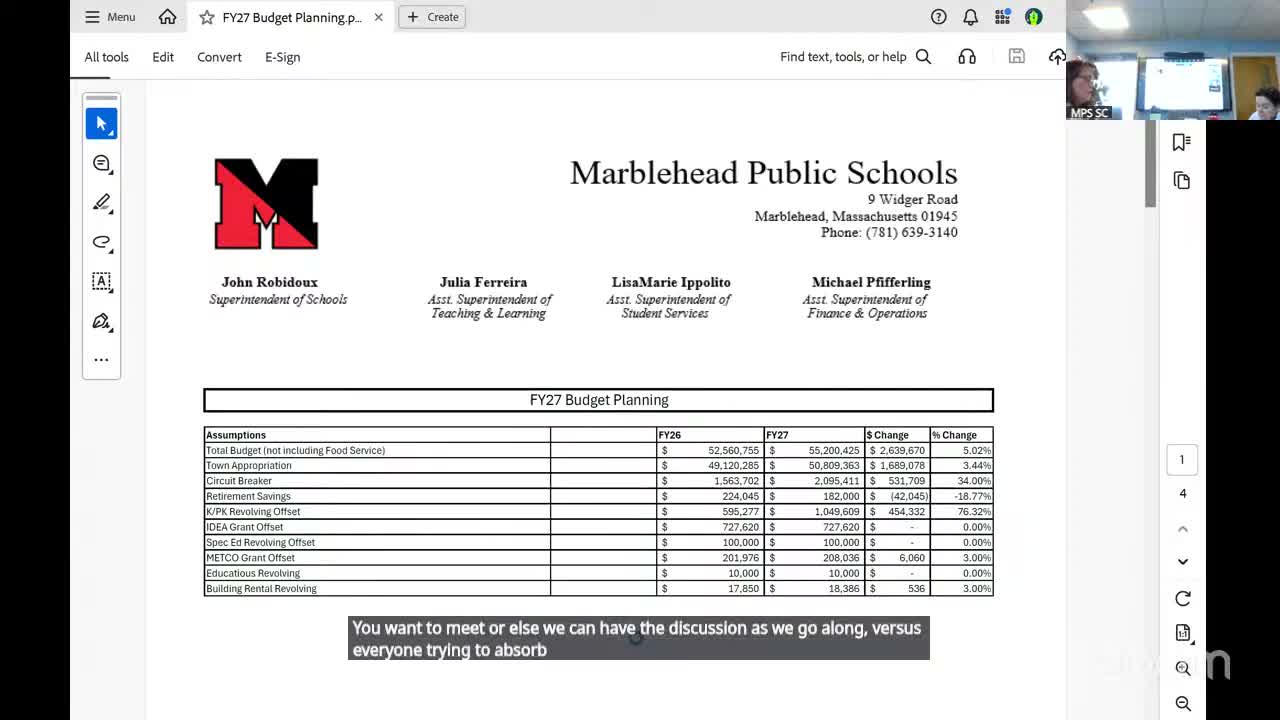
Summary
Superintendent's team outlined a FY27 level-service package that produces a $806,000 gap after applying one-year offsets; the administration proposed using revolving funds, reallocating grant administrative costs, and identifying five positions and other reductions to limit classroom impacts. A public budget hearing is set for Feb. 26.
Marblehead Public Schools' administration presented a FY27 level-service budget that would increase district spending by about $2.6 million compared with the current year but still leaves an $806,000 gap the district must close to meet the town's level-funded directive.
At a budget subcommittee meeting, Mike (first referenced in the transcript by first name only; role/title not specified) told committee members the FY26 total district budget excluding food service is $52,500,000, of which the town appropriation is $49,100,000. He said timing and one-time items ' notably a larger circuit-breaker reimbursement this year and reallocation of pre-K/kindergarten revolving funds ' reduce the amount the administration will ask from the town next year to about $1.7 million over the town appropriation, down from a full $2.6 million level-service increase.
The administration offered several levers to trim one year of costs without immediately increasing classroom sizes, including:
- Reallocating roughly $81,000 within the IDEA grant by not contracting two planned fellows and using existing grant lines for other services.
- Moving 10% of the assistant business manager Briston Morello's salary from the town (LEA) budget into grants and the kindergarten/pre-K revolving account (estimated savings of about $23,000).
- Shifting half of the assistant student services director salary to a special-education tuition revolving account as a one-year measure (district notes that account currently contains roughly $100,000 and is being used for salaries now).
- Reducing the prepaid tuition set-aside from $1,000,000 to $800,000 to free $200,000 in FY27 cash flow.
- Identifying 'hurting' reductions that the administration characterizes as targeted to minimize student-facing harm: five identified positions (the administration hopes attrition and retirements will avoid layoffs), a 0.4 EL teacher restructure, eliminating one general education instructional assistant at the elementary level, reductions in some contracted special-education services (about 10%), and delaying or holding vacancies such as a teacher-in-charge and a summer IT position.
The administration flagged several capital and maintenance needs that would not be covered by one-year fixes: a wireless access-point replacement plan was submitted to the town as part of capital/override requests, and Steven (first name only) requested roughly $292,000 to upgrade technology hardware and software. Mike said heating fuel supply costs are projected at roughly $490,000 next year (about $19,000 lower than prior estimates) and that electricity budgets were reduced based on 18 months of history (an estimated 8–9% reduction).
On transportation, the administration noted special-education and out-of-district transport costs have risen and said it is exploring consortium options (the transcript references a regional vendor, Next Transportation) that may save money but previously required startup buy-in.
Chair and members pressed for clarity on classroom impacts; the administration said it prioritized cuts that avoid increasing elementary class sizes and would first target high-school or non-core roles if additional reductions are required.
The committee and administration set a public calendar: the recommended budget will be presented to the full school committee on Feb. 5 (posted Feb. 6), with a public budget hearing scheduled for Feb. 26 and a likely committee vote at the first March meeting. The administration expects to refine the materials and post a budget book with line-item detail before the hearing.
Next steps: the administration will finalize slides and the budget book for the Feb. 5 presentation, prepare deeper revolving-account detail requested by committee members, and return with a revised recommended budget and any updated estimates that change the $806,000 gap.