
Union urges committee to protect collective bargaining as Empowerment Zone schools return
Get AI-powered insights, summaries, and transcripts
Subscribe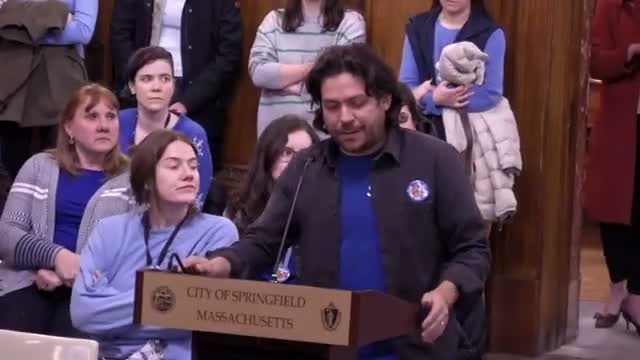
Summary
Riley Hernandez, president of the Springfield Education Association, presented a petition asking the committee to negotiate a mutual agreement ensuring waivers in returning Empowerment Zone schools will be subject to collective bargaining in 2028; he said educators received insufficient answers about bargaining status and five-year prospectus locks.
Riley Hernandez, president of the Springfield Education Association, told the committee that educators in eight schools transitioning out of the Springfield Empowerment Zone are seeking a clear guarantee that waivers and working-condition changes outlined in the prospectus will be subject to collective bargaining when contracts expire in 2028.
Hernandez said the prospectus submitted to the superintendent "identifies waivers from the district contract and replaces those provisions with language from the Springfield Empowerment Zone contract," but that the nature of those waivers "was never actually negotiated with the SEA and its members." He described the process as "entirely conducted in a top-down manner" and likened it to labor-management relationships more typical of charter school networks than a public school system.
Key questions Hernandez asked the committee included when innovation-school educators will be able to collectively bargain, which bargaining sessions they will attend, and which unit they will belong to if the prospectus locks in a five-year innovation plan. He urged the committee to "come to a mutual agreement with the members of the SEA that says, the waivers outlined in the prospectus will be subject to collective bargaining in 2028 as part of the district's bargaining process." He said such an agreement would facilitate the two-thirds educator approval needed at the school level and smooth the transition back under district management.
The committee acknowledged the concerns during public comment; the transcript shows no formal vote or immediate commitment to the specific mutual agreement during the meeting. Hernandez said he looks forward to working with the committee to reach an accord.