Charlottesville staff project about $11 million in new revenue but flag a persistent budget gap
Loading...
Summary
City staff presented FY2027 budget guidelines and policies and estimated roughly $11 million in new or revised revenues, while warning of continuing expenditure pressures — collective bargaining, school funding requests and debt service — that leave a budget gap to resolve before adoption.
City staff opened the FY2027 budget work session with an overview of budget guidelines and a first read of revenues and expenditure pressures, estimating roughly $11,000,000 in new or revised revenue but saying a gap remains to be closed before the March budget delivery.
Miss Hamill, the staff presenter, outlined the budget framework the council uses each year: review of major local tax rates, development of balanced operating budgets, dedication of at least 40% of new real-estate tax revenue to schools (a figure the city historically has often exceeded) and a transfer equivalent to 1% of meals-tax to debt service. She told the council the city maintains a general fund balance policy target of 14% and a 3% downturn reserve for a combined 17% fund balance, which rating agencies review.
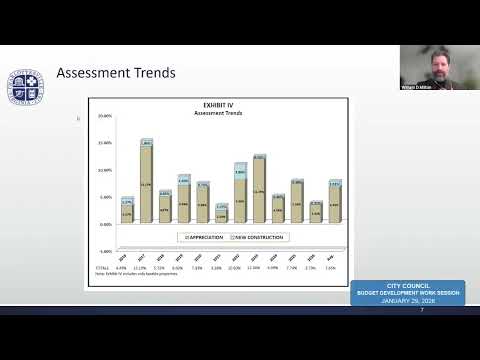
The presentation included a first look at revenues: reassessment-driven increases account for roughly $3.9 million of the gains, and meals and sales taxes showed modest recovery. Miss Hamill estimated the city has about $11,000,000 in potential one-time and ongoing revenue to allocate for FY27 once designated transfers and revised numbers are included, though she cautioned those figures could shift as another month of receipts is added.
On the expenditure side, staff identified major cost drivers: employee compensation and benefits, several collective bargaining contracts (police, fire, transit, Teamsters), a jail renovation with larger debt-service beginning in FY27, and ongoing increases in annual debt service of roughly $1 million per year. Miss Hamill said staff had incorporated those fixed costs into baseline projections.
City Manager Sam Sanders told the council he had begun pulling levers — adjusting assumptions and assessing requests — and had already informed the school superintendent that the full $6.4 million schools’ ask would probably not fit within the current assumptions. Sanders said staff would continue refining numbers and expected to signal within days whether tax discussions would be necessary as part of the final balancing exercise.
The council was reminded that advertisement deadlines and the public hearing schedule mean any decision about changing tax rates would need to be made quickly: the tax-rate public hearing is scheduled for March 16, and staff aimed to have a balanced budget ready to circulate by February 13. The manager said staff would return with specific tradeoffs and recommended “methodologies” for using one-time funds such as developer proffers.
The work session concluded with further staff follow-up promised on specific requests and assumptions; no formal votes on budget policy or tax changes were taken at the session.