Get Full Government Meeting Transcripts, Videos, & Alerts Forever!
Get email alerts on the Abatement Enforcement topic
No spam. Unsubscribe anytime.
Jim Wells County sheriff tells court nuisance abatement is civil administrative process, not criminal enforcement
Summary
Sheriff Joe Scott Baker told the commissioners court that the county's nuisance-abatement process is an administrative civil procedure under county rules and state law, not a prosecution-driven patrol function, and urged alignment of expectations, funding and formal communication protocols.
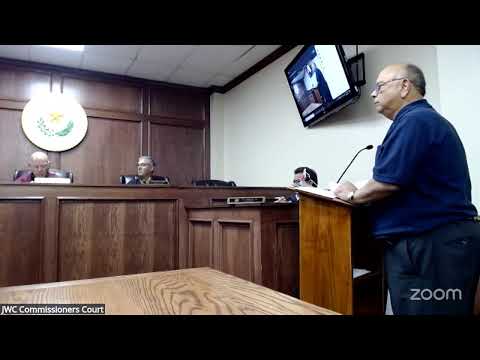
Joe Scott Baker, sheriff of Jim Wells County, told the commissioners court on Jan. 29 that county nuisance abatement is a civil administrative process established by the court's adopted procedures and not a criminal enforcement program.
Baker said he filed a memorandum to correct what he described as "factual, legal, and procedural misunderstandings" from an earlier court discussion and repeatedly emphasized that enforcement authority and responsibilities are defined by the court's adopted order of May 13, 2024.
"Under the county's adopted procedures, nuisance abatement is a civil administrative process, not a prosecution-driven function," Baker said, adding that "using criminal case totals as a performance metric directly contradicts the structure and purpose of the court's adopted process." He described such characterizations as "inaccurate and...false."
Baker reviewed the sequence the order requires: written complaints, administrative inspections, determinations, a notice to abate, 31-day compliance periods, hearing opportunities and the court's authorization before county-initiated abatement. "Nothing in the order authorizes deputies to issue citations, seize property, or compel abatement absent compliance within these procedures," he said.
He also addressed specific enforcement gaps raised in recent discussion, including illegal dumping and calls for a 72-hour parking restriction. Baker said the county's public-nuisance definition includes time, visibility and location thresholds and that a separate ordinance would be needed to create a 72-hour parking rule and grant deputies enforcement authority for it.
The sheriff said some commentators had asserted that complaints received no response, but he said those claims lacked dates or written documentation. "The order requires written complaints," he said, and public statements do not substitute for a documented notice or administrative review.
Baker described the sheriff's nondiscretionary duties that affect expenditures: inmate custody, court-ordered transports, emergency mental-health detentions and juvenile transports. He said contract transports save "over $650 per transport" compared with using county staff and that roughly half of January transports were handled by contract. He offered the sheriff's office's willingness to participate in "structured good-faith discussion[s]" about abatement enforcement so long as those talks are grounded in an adopted ordinance, realistic expectations, appropriate tools and funding, and formal communication protocols.
The court acknowledged Baker's remarks and proceeded to the next agenda item.