Lifetime Citizen Portal Access — AI Briefings, Alerts & Unlimited Follows
Albert Lea task force reviews community feedback and six consolidation options amid declining enrollment and budget gap
Loading...
Summary
Task force members reviewed input from two listening sessions and worked through six facility-consolidation options — including grade reconfigurations, Brookside conversions, and a 7–12 high-school alternative — and asked administration to model financial and enrollment impacts before making recommendations.
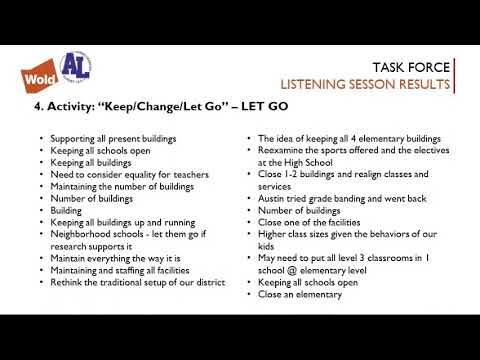
Unidentified Speaker 1, the meeting facilitator for the ALBERT LEA PUBLIC SCHOOL DISTRICT task force, opened the session and reviewed outcomes from two community listening sessions held Jan. 8 and Jan. 12. The facilitator said about 31 people completed worksheets at the meetings and the district received only a handful more survey responses afterward.
The group focused on results from the worksheets, which ranked priorities. "Educational quality and programming" was the top-rated value (38 selections), followed by "fiscal responsibility to the community" (22), the facilitator said. Participants repeatedly emphasized concerns about declining enrollment, capacity/utilization, and family logistics if schools were reconfigured.
Task-force staff presented six sanitized option packets for group work — Advance, Ascend, Elevate, Forward, Ignite and Inspire — each accompanied by back-page enrollment-projection math. Staff noted that closing a single elementary could produce an illustrative annual savings on the order of hundreds of thousands of dollars; one example used at the meeting cited roughly "$693,000" as a conservative annual savings estimate driven primarily by staffing, utilities and maintenance reductions, but staff stressed that closure alone would not cover the district's projected multi-million-dollar shortfall.
Speakers and participants debated the options on educational and operational grounds. Concerns included co-locating alternative-learning programs (ALC) with pre-K (participants said parents often view such pairings unfavorably), renovation costs to convert spaces such as Brookside back into classrooms, and the feasibility of keeping specialty programming if buildings are closed or moved. Several attendees repeatedly urged caution about grade banding (moving grades between buildings), citing family convenience, multiple student transitions, and classroom-configuration challenges such as lab space at the high school.
A number of peer-district examples were raised: Winona was cited as selling buildings for several hundred thousand dollars, while another district listed a property for $1 after a long vacancy. Staff cautioned that resale proceeds are unpredictable and market-dependent and recommended assuming little or no sale revenue in planning unless marketability is clearly established.
The task force also discussed non-closure options and efficiency gains that could reduce costs, including energy projects. Staff described a solar-for-schools grant program (grant awards discussed in the meeting were in the roughly $100,000–$180,000 range) and noted some sites either qualified or did not based on program criteria.
Group feedback during the timed worksheet exercise produced no single consensus option. Several members expressed interest in a variant of the "Elevate" or "Inspire" concepts that would place grades 7–12 at the high school, while others preferred incremental or phased changes (for example, moving pre-K without immediate grade banding). Participants asked administration to run detailed financial models — including transportation, staffing, renovation and utility impacts — and to return with multiple scenarios. Staff committed to updating projections after the district's February budget and enrollment updates.
Before adjournment, participants raised communications and referendum considerations; one participant urged the district to be explicit that potential school closures and any operating referendum are distinct decisions that must be clearly explained to the public. The task force left next steps open but agreed to have administration model multiple options and likely reconvene once updated fiscal and enrollment information is available.