Lifetime Citizen Portal Access — AI Briefings, Alerts & Unlimited Follows
Board hears SB 141 briefing: new measures, supports and a state dashboard by 2028
Loading...
Summary
District staff briefed the Douglas County SD 4 board on Oregon Senate Bill 141, which adds K–2 attendance and eighth-grade math as accountability measures, requires interim K–8 assessments, streamlines grant reporting and mandates a public data dashboard planned for 2028.
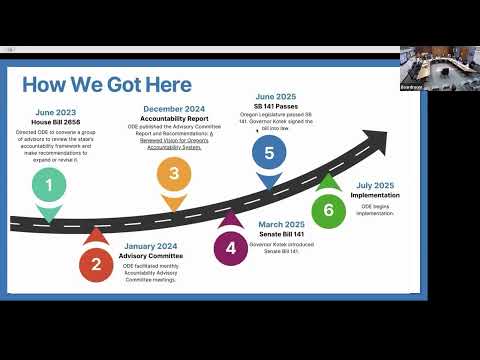
District staff and presenters briefed the Douglas County SD 4 Board of Education on Senate Bill 141, outlining what the new state accountability law will require and how the district expects to respond.
Presenter (speaker 9) described SB 141 as "Oregon's educational accountability act," and said the law adds K–2 attendance and eighth-grade math scores to statewide accountability measures, requires interim assessments in math and English language arts for K–8 and creates a local-metric choice the district will later present to the board. Staff emphasized that the district already uses interim assessments and several of the locally allowed tools are ones the district currently employs.
Presenters said the law directs the Oregon Department of Education (ODE) to streamline grant reporting and to develop public data dashboards that will include financial, educator workforce and accountability information. Staff noted the dashboard is expected to be fully launched in 2028. They also explained a staged accountability response: after two years of missing targets districts must accept coaching; after three years they enter intensive coaching and may receive additional funding according to rules; and after four years ODE could be authorized to prescribe up to 25% of the state school fund for a district under the bill's framework — a shift staff flagged as significant and still contingent on rulemaking by the State Board of Education.
Board members asked about how districts were selected for pilots, whether pilot participation brings extra funding, how much influence districts have in metric selection, and how ODE is organized to offer supports. Staff said this district was among 34 pilot districts chosen for the grant consolidation work because of a mix of size, location and poverty indicators and that being a pilot does not in itself guarantee additional funding. Staff stressed districts will meet with ODE to set district targets once the State Board finalizes metrics.
Several board members raised concerns about ODE's current structure and capacity to provide systemic improvement supports instead of compliance monitoring. Staff acknowledged rules are still being written, that the district is providing feedback in monthly pilot meetings and that they will continue to update the board as rulemaking and implementation evolve.
Next steps: staff will review midyear assessment data in February, present local metric options for the board's consideration, and continue participation in ODE pilot work and rulemaking discussions.