
Candidate Michael Gregg frames research on conflict responses, military corruption and China implications
Get AI-powered insights, summaries, and transcripts
Sign Up Free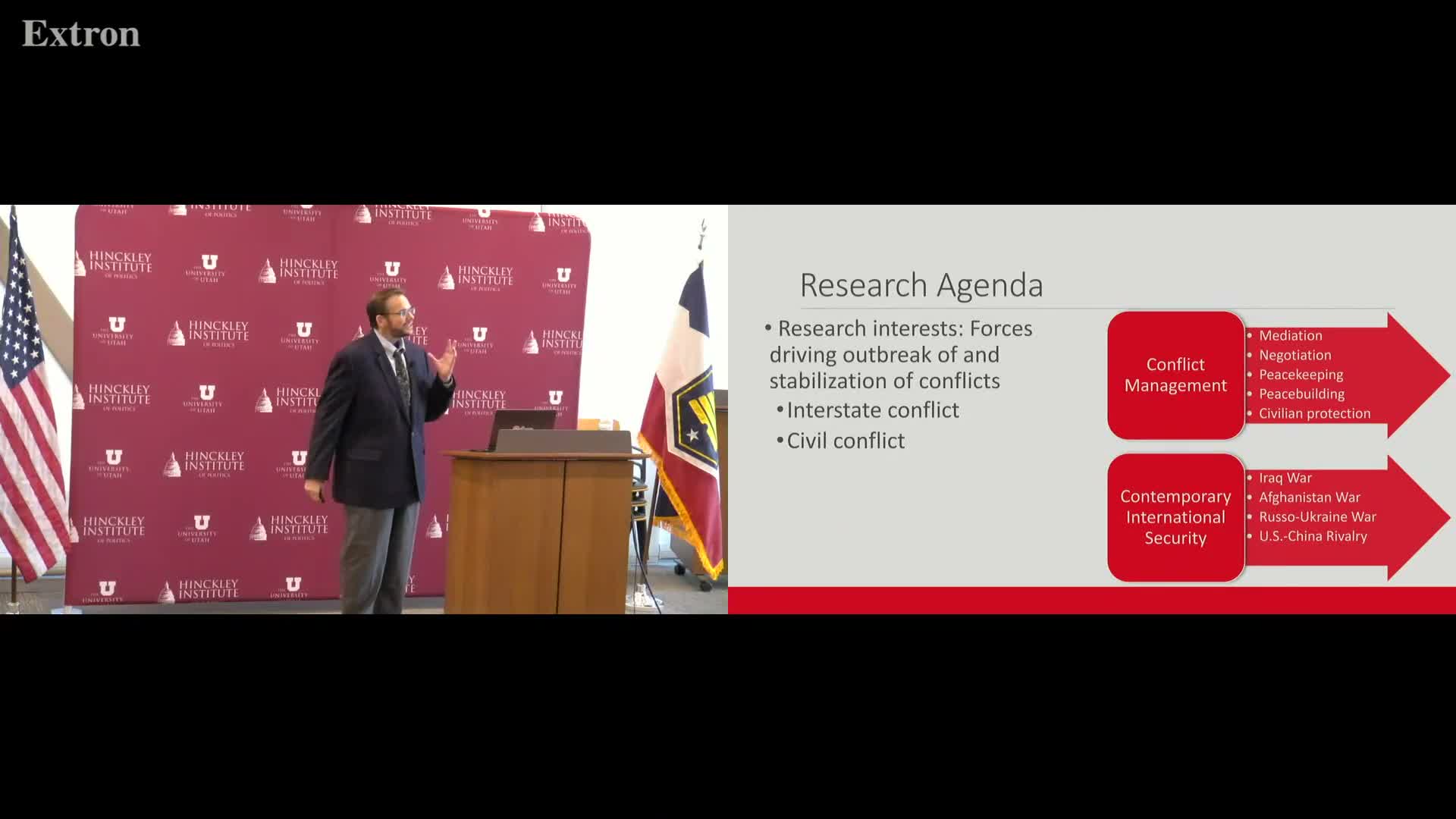
Summary
At a Hinckley Institute presentation, Michael Gregg outlined research on why insurgents alternately aid civilians or increase violence after natural disasters and on how corruption degrades military effectiveness — drawing implications for personalist regimes and the PLA.
Michael Gregg, a candidate for professor and department chair, told attendees at a Hinckley Institute of Politics presentation that his research focuses on what drives the outbreak and stabilization of conflict and how those forces shape combat and civilian outcomes. Gregg, who said he currently serves as associate chair for international studies at the University of North Texas, described two main research agendas: conflict management (mediation, peacekeeping and civilian protection) and contemporary security (corruption and military effectiveness).
Why insurgents sometimes aid civilians after natural disasters and other times exploit the chaos is a central puzzle in Gregg’s conflict-management work. "There are cases where groups step in and provide emergency response," he said, citing recent examples in Syria and Pakistan, and others where militants "amped up their violence." He argued that a group’s internal governance—centralization, leadership control, and ties to civilian resources—conditions its response: more-centralized groups with stable leadership are likelier to pursue longer-term governance strategies, while groups tied to illicit economies are likelier to engage in short-term, violent exploitation.
Gregg said governments’ actions also matter: declarations of emergency can signal weakness to civilians and external actors and shift insurgent incentives. He described next steps to map natural-disaster locations against data on rebel territorial control to test these mechanisms.
In his contemporary-security agenda, Gregg described research showing how public-sector theft and corruption can erode a military’s combat capacity and morale. "A highly corrupt government undermines its military effectiveness by diverting resources away from fighting," he said, noting problems such as "ghost soldiers" and siphoned training and supplies that leave leaders unaware of actual capacity.
He said the effect is especially acute in personalist regimes—those dominated by patronage and a strong cult of personality—because such systems are both more prone to corruption and less likely to detect or correct it. Gregg linked that logic to recent high-level anti-corruption arrests in China’s military and said the pattern has possible implications for PLA performance in any future conflict scenarios.
Gregg said his findings have been accepted at the Journal of Conflict Resolution and that follow-on pieces and analyses (including a Foreign Affairs submission under clearance) build on data from sources such as UCSD after the termination of some dedicated grant programs. He emphasized the policy relevance of studying how corruption and governance shape both insurgent behavior and state fighting capacity.
The presentation closed with Gregg outlining planned empirical steps and inviting detailed questions about methods and data in a follow-up Q&A.