
Legislative panel hears competing higher‑education budgets as LFC favors base funding over new grants
Get AI-powered insights, summaries, and transcripts
Subscribe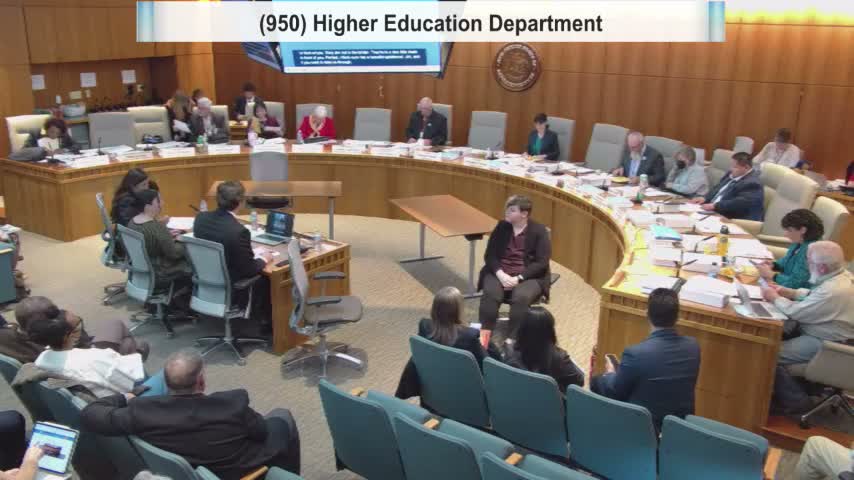
Summary
The Legislative Finance Committee reviewed the Higher Education Department budget, where the LFC recommends a larger increase to core (ING) funding and fewer new RPSP grants than the executive branch, while members pressed officials on student retention, scholarship deficits and tuition language.
Connor Jorgensen, the LFC analyst for higher education, told the Legislative Finance Committee that New Mexico has seen four years of enrollment growth but remains low in degree attainment, with fall‑to‑fall retention at about 72% compared with a U.S. average near 82%.
Jorgensen said the LFC recommends $42.1 million in new money for higher education in FY27 — a 4.7% rise for instruction‑in‑general (ING) — compared with the executive recommendation of about $30.8 million (a 3.4% ING increase). The LFC guidance directed more new funds into ING rather than new research and public service projects (RPSPs), leaving many institution‑specific grant requests unfunded this year.
The difference, he said, allows institutions flexibility to use recurring funds for priorities such as student supports, tutoring, advisement and mental‑health services. Jorgensen highlighted LFC proposals that include $5 million for student supports and $1.5 million for medical‑faculty compensation increases at research institutions.
Secretary Stephanie Rodriguez, presenting the executive’s case, emphasized degree production and workforce alignment, saying the department’s budget supports roughly $1.3 billion to institutions and requests targeted RPSP funding to cover lost federal grants and program starts. She noted the administration’s priority to move high‑performing nursing programs into the ING base and reiterated RPSP requests that include public broadcasting and workforce initiatives.
Committee members from both parties pressed officials on performance measures, how student supports are tracked and whether ING flexibility will actually fund new initiatives such as AI centers and workforce tracking. Analysts responded that ING dollars are largely undesignated, so institutions could deploy them for faculty, student services or program supports at their discretion, while noting that LFC chose not to fund most new RPSPs in the packet.
Members also asked how the two recommendation sets treated tuition and scholarship risks, the funding formula tweaks that shift weight to end‑of‑course credits, and how the Higher Education Trust Fund (capitalized at $1 billion and generating about $50 million annually) is being used to support the Opportunity and Lottery scholarships.
The committee adopted the LFC recommendation for the covered agencies during the same session, after a motion by Vice Chair Dixon and seconding by Ranking Member Chatfield; Representative Dow was recorded in opposition to one block vote.
The committee will continue to weigh institution requests against the LFC guidance favoring broader ING increases, with members requesting additional documentation on specific RPSP items and performance data for student supports.