
Clay County superintendent outlines midyear ‘financial renaissance,’ recommends 1‑mill referendum to shore up revenue
Get AI-powered insights, summaries, and transcripts
Subscribe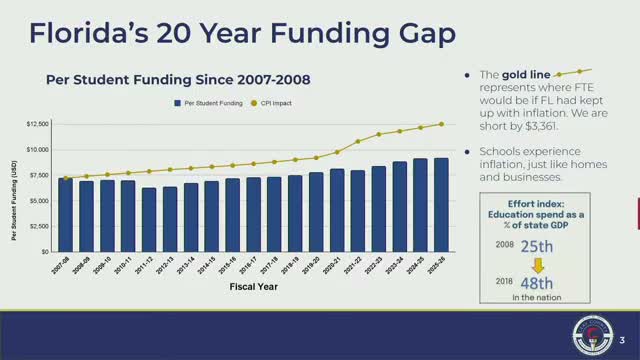
Summary
Superintendent Brodsky told the board a combination of state funding changes, voucher growth and federal timing created a multi‑million dollar shortfall; he recommended putting a 1‑mill referendum before county voters to protect student safety and fund employee compensation.
Superintendent Brodsky presented a midyear financial update at the Clay County School Board workshop on Jan. 27, saying the district faces an unprecedented funding challenge driven by state policy changes and shifting enrollment patterns. He told the board that a mix of factors — including the rapid expansion of the state’s family empowerment voucher program, withheld federal Title funding, and a higher Florida Retirement System (FRS) liability — combined to produce a roughly $60 million shortfall in the district’s preliminary modeling.
Brodsky said statewide shifts have left Florida among the lower tiers of per‑pupil funding and that an Auditor General review of the voucher program raised accountability concerns. Locally, he reported about 4,500 Clay County students use vouchers, and roughly 4,000 of those students have never attended Clay County Public Schools, a dynamic he said diverts about $30 million annually from district classrooms to private school vouchers.
The superintendent described the district’s immediate actions to narrow the gap: reviewing and reducing contracts, conducting program return‑on‑investment analyses, pausing nonessential travel, and reducing some district and school budgets. He said staffing remains the largest cost (about 82% of the general fund) and that reductions were made with an emphasis on minimizing classroom‑level impact and offering positions where possible to affected employees.
Brodsky provided a ‘halftime’ snapshot of expenditures, noting payroll tracking improvements and that many budget categories are near the expected 50% expended at midyear. He warned that the district’s required 3% fund balance (roughly $11.52 million in Clay County) is less than a single payroll cycle and described the statutory consequences if the fund balance falls between 2% and 3% (a required recovery plan) or below 2% (state intervention).
To increase revenue, Brodsky formally recommended the board consider placing a 1‑mill referendum on the ballot. He said the millage has historically funded student safety needs in Clay County and that neighboring counties use similar local dollars to remain competitive on staff compensation. Brodsky outlined a timeline for drafting referendum language and for county commission milestones if the board wishes to proceed.
Board members asked detailed budgeting and implementation questions; no formal vote was taken on the recommendation during the workshop. Brodsky characterized the proposal as necessary to preserve safety contracts and maintain competitive compensation in a constrained fiscal environment.
The district framed next steps as staff work to refine referendum language, model fiscal impacts, and present ordinance language and calendar milestones to the board and county commission for decisions later this spring.