
Committee hears rest-area paving plans, EV‑charger constraints; town‑highway disaster and clean‑water grants outlined
Get AI-powered insights, summaries, and transcripts
Subscribe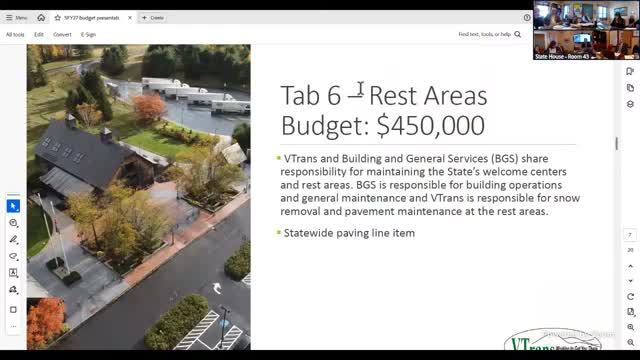
Summary
AOT told the committee rest-area paving is in the FY27 budget but federal restrictions limit commercial activity at rest areas; members discussed adjacent land or public–private partnerships for Level‑3 EV chargers. AOT also outlined town‑highway disaster reimbursements and Clean Water Fund‑backed Better Roads grants.
Agency staff told the committee there is not much new in the rest‑area line beyond a statewide paving allocation, and that rest areas—built largely with federal dollars—face restrictions on commercial activities that limit direct charging or commercial vending.
Representative White and others asked whether Level‑3 EV chargers could be sited adjacent to rest areas on state‑owned or privately purchased land so users could access bathrooms and facilities while charging. AOT staff said that to avoid federal restrictions they would likely need to use state funds or pursue a public‑private partnership and that the agency would follow up; staff also noted Patrick Murphy would provide additional details later.
Town‑highway disaster response: Parago described Tab 20 as a placeholder for projects related to recent storms and emergency relief. He said there are 39 ongoing municipal‑assistance projects from the last two storm events (30 emergency relief projects) and nine identified permanent restoration projects; much of the current work is documentation to secure federal reimbursement.
Clean Water Fund and Better Roads: Parago outlined a $6,143,000 line that includes multiple grant programs: Better Roads ($1.4M total, of which $1.0M comes from the Clean Water Fund and $440k from the Transportation Fund) and a $3.0M grants‑and‑aid program funded by the Clean Water Fund that helps municipalities comply with the Municipal Roads General Permit. He said 237 of 260 municipalities received grant funding under that program in FY26.
Why it matters: those programs link transportation funding with municipal road maintenance and water‑quality compliance, and they provide funding that many towns use for public‑works improvements after storms or to meet permit obligations.
Next steps: AOT staff offered to look up town‑specific project listings and to follow up with members about potential EV‑charging siting and municipal project statuses.