
AOT budget presentation: carbon reduction, PROTECT resilience projects and hazard mitigation noted
Get AI-powered insights, summaries, and transcripts
Sign Up Free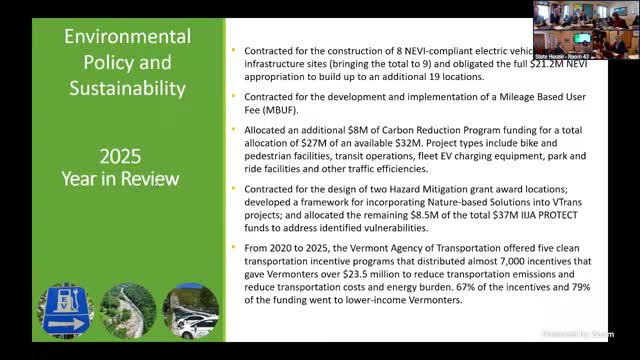
Summary
Agency of Transportation staff told the House Transportation Committee the Environmental Policy & Sustainability program is managing multiple federal funding streams (NEVI, Carbon Reduction, PROTECT), contracted two hazard mitigation designs and allocated about $27M in carbon reduction funds to multimodal and electrification projects.
BURLINGTON, Vt. — Agency of Transportation staff detailed how the Environmental Policy & Sustainability program is allocating federal grants and state match during a Jan. 29 House Transportation Committee hearing, highlighting carbon reduction, resilience, and program staffing.
Andrea Wright, environmental policy manager, said the program supports climate initiatives across agency programs and coordinates with the Climate Action Office, the treasurer’s office and Vermont Emergency Management. Wright said the agency “contracted for the construction of 8 additional NEVI targeting infrastructure locations” and that, in the budget presentation, approximately $8,000,000 of Carbon Reduction Program funds were newly allocated, bringing allocations to about $27,000,000 of an available $32,000,000 pool for eligible projects.
On resilience, Wright described two hazard mitigation design contracts: an engineered log‑jam floodplain stabilization project along VT‑117 in Jericho and a culvert‑upsizing project in Smuggler’s Notch. She said construction for these projects is anticipated in state fiscal year 2027 and the agency budget includes staff time and some construction funding; FEMA reimbursement remains a possibility but is unconfirmed.
Wright explained PROTECT funding match rules are complex and vary by project type: some resilience projects identified on the resilience improvement plan (RIP) can qualify for higher federal share under a 90/10 split while other projects receive 90/10 only on incremental resilience costs. She said PROTECT requires at least 2% of funds go to planning, a line item the agency carries in its budget.
Committee members pressed on staffing and match accounting. Wright said Transportation Fund revenues appear down about 5% in the presented budget and that the large overall increase (57%) reflects timing of NEVI and PROTECT construction dollars coming through the budget; she added state carry‑forward funds will be used to meet CRP match expectations where necessary.
Wright closed by noting the program will submit its annual report by Jan. 31 and is prepared to return with more detail on the NEVI solicitation and project allocations.