Get Full Government Meeting Transcripts, Videos, & Alerts Forever!
Get email alerts on the Sea Level Rise Adaptation topic
No spam. Unsubscribe anytime.
Carmel-by-the-Sea commissions review draft sea-level-rise adaptation pathways, prioritize monitoring and sand-source study
Summary
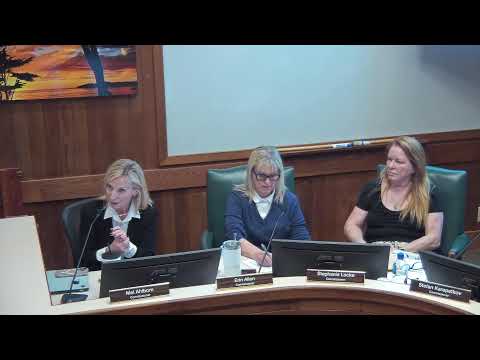
At a joint meeting, Carmel-by-the-Sea planning and forest-and-beach commissioners heard a draft Adaptation Pathways report that frames near-term monitoring triggers, sand-sourcing feasibility and policy steps for a Local Coastal Program update required under SB 272; staff will draft policies for Planning Commission review this year.
Carmel-by-the-Sea planning and Forest and Beach commissioners on Tuesday heard a presentation of a draft Sea Level Rise Adaptation Pathways report that lays out monitoring triggers, near-term actions and long-term options — including beach nourishment, engineered armoring and managed retreat — to respond to rising seas and coastal erosion.
"The Coastal Commission requires that local coastal programs be updated to consider sea level rise," Anastasia Aziz, a principal with EMC Planning Group, told the joint meeting, noting the work is grant-funded and intended to feed into an LCP amendment. The group said Senate Bill 272 sets a state requirement for coastal communities to adopt sea-level-rise plans by 2034.
The consultants divided the city’s shoreline into three planning areas — North Beach, Central Beach (including the Del Mar access and 8th Avenue emergency access) and South Beach/Scenic Road — and presented scenarios tied to roughly 1-, 2- and 4-foot sea-level-rise benchmarks. "With 4 feet of sea level rise, most of the beaches would likely disappear except for some very small pocket beaches," Dave Bridal, a principal and geomorphologist with Integral, said, adding that higher water levels would increase wave overtopping and accelerate bluff failures that can undermine building foundations.
The report frames responses as a sequence of adaptation pathways. Near-term recommendations include establishing a monitoring and maintenance program the Coastal Commission can certify, maintaining and repairing existing stairways and revetments efficiently, and pursuing studies to identify compatible sand sources for beach nourishment if feasible. The plan emphasizes measurable "triggers" — for example, reductions in beach width, frequency of seawall overtopping or the exposure of bedrock — that would prompt planning and implementation of the next strategy.
Commissioners pressed consultants on two recurring decision points: whether regulatory agencies would favor nature-based solutions and whether there is compatible sand that can be obtained and placed on the beach. "We cannot speak for the Coastal Commission," Bridal said, "but they generally prefer approaches that maintain natural resources and public access where possible, and permitting for innovative projects can be lengthy." He added that if a supply of compatible sand is available and permitted, the city would have more nature‑based options; if not, the city would face a different set of engineering-focused strategies.
Several commissioners raised community trade-offs that emerged in public workshops and the project survey: the town highly values the current sand’s color and texture, and residents may resist changing that character. "If indeed there's a choice between us losing Carmel Beach and us matching the sand, I would be leaning towards saving the beach rather than matching the sand," said Commissioner Alborn.
Concerns about surf quality and recreation also surfaced. Bridal said nearshore reefs can be designed for multiple objectives (habitat, protection, surf amenity) but would require surf-quality impact assessments and community input before being advanced.
The consultants identified potential funding sources for feasibility and monitoring work, including the California Coastal Commission, the Coastal Conservancy, the Ocean Protection Council and the Strategic Growth Council. They described a likely policy path: draft policies returned to the Planning Commission for recommendation this summer or fall, a City Council review in late 2026, and subsequent Coastal Commission review and certification with likely edits.
Commissioners asked for a concise city-specific summary of immediate and near-term recommended actions (for example, locations with deferred maintenance, monitoring priorities and rough cost ranges); staff and consultants agreed to prepare a short action summary and to scope a prioritized sand‑source feasibility study. Bridal estimated a very rough, back-of-envelope ballpark for large-scale nourishment (without regulatory or mitigation costs) in the low millions, but emphasized that permitting, mitigation and method of delivery could raise costs substantially.
No formal action was taken at the meeting; staff said the draft adaptation pathway will be revised based on feedback, additional Coastal Commission input and further technical work, and that the team will return with draft LCP policies for commission consideration.
What’s next: staff will post revised materials on the project webpage, the consultants expect to receive Coastal Commission staff comments in coming weeks and will incorporate them, and the Planning Commission will be asked to review draft policies later this year to inform Council action and eventual Coastal Commission certification.