
Talent board reviews RFQ draft for Gateway site; members press for clearer outreach, parking and affordability language
Get AI-powered insights, summaries, and transcripts
Subscribe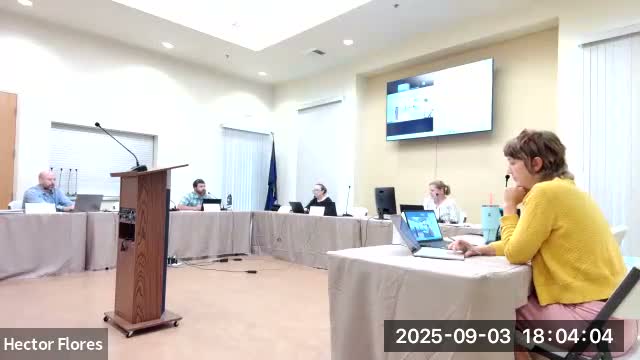
Summary
Board and consultant reviewed a near-final RFQ for redevelopment of the Gateway site, discussed posting and outreach, debated parking/zoning references and housing targets (80–120% AMI), and noted a precautionary conflict disclosure by an attending member tied to the Talent Business Alliance.
The City of Talent board reviewed a near-final request for qualifications for redevelopment of the Gateway site at its meeting on September 3, focusing discussion on outreach, zoning references and how the RFQ frames housing and commercial priorities.
Consultant Matt Brinkley of Greentop Planning presented the draft and said it reflects earlier direction, noting the RFQ emphasizes a commercial component and references an incubator hub. "We had just received the commercial feasibility study, and so that's mentioned in here," Brinkley said, adding the study will be sent with the RFQ. He and staff said the RFQ will be posted on the City of Talent RFP/RFQ page and emailed to developers; they also plan to post it on development-oriented sites and professional groups.
Board members urged clearer public-facing communications beyond developer outreach, pointing to a previous RFQ round that drew little public engagement. A member said earlier outreach shortfalls led to a single selected applicant in the prior process; Brinkley and board members agreed on the value of a user-facing web page and press outreach.
Members raised specific content concerns. Several asked that the RFQ clarify zoning and parking references where municipal code and recent state changes differ; staff said the RFQ's zoning descriptions are correct but acknowledged the need to note recent and pending code changes. On multimodal design, one member asked the RFQ to call out secure bicycle storage explicitly rather than rely solely on general "multimodal" language; Brinkley agreed to add language in the urban design and architecture section.
Housing targets drew sustained attention. Board members asked for firmer wording and an explicit definition of "middle housing" as 80–120% of area median income (AMI) so respondents will not receive mixed signals. Staff and members discussed aligning the RFQ scoring rubric to prioritize affordability and commercial uses and to present the rubric in a clearer tabular form.
On process, staff said the city can delay RFQ dates to allow adequate response time and try to align developer selection with an engineering RFP schedule. Staff proposed returning a final scoring table and revised RFQ at the next meeting.
Separately, an attending member declared a precautionary potential conflict relating to their employment: the member said they were "paid staff with the Talent Business Alliance," which had proposed the incubator hub mentioned in the RFQ. The transcript does not attach a name to that exact statement; the meeting record also notes a member arrival immediately after the declaration.
The board directed staff and the consultant to incorporate the edits discussed, produce a clearer scoring table, and return the RFQ for final review at a subsequent meeting.
The RFQ item concluded without a vote; staff will circulate a revised draft for the board to consider at the next meeting.