
CDFI reports nearly $30M deployed and 1,100 units financed under Hamilton County ARPA housing program
Get AI-powered insights, summaries, and transcripts
Subscribe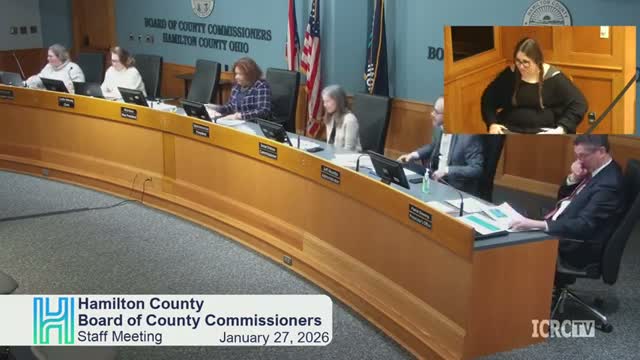
Summary
Luke Blocker of a Cincinnati community development finance intermediary told commissioners the Hamilton County ARPA Affordable Housing Program has deployed almost $30 million (of roughly $33.5M–$36M), financed nearly 1,100 units to date, leveraged about $344 million in additional investment, and is targeting March–April to finalize remaining commitments including a tiny-homes application now under review.
Luke Blocker, representing a Cincinnati community development finance intermediary (CDFI), briefed commissioners on Jan. 27 on the county’s American Rescue Plan Act (ARPA) Affordable Housing Program, a contract partnership executed in December 2022.
Blocker said the program has deployed almost $30 million of the county’s allocation (originally cited at about $33.5 million, later discussed as roughly $36 million after additions) across about 30 projects and has leveraged approximately $344 million in other investment. He said the program has financed nearly 1,100 housing units to date, exceeding the original contractual aspiration of about 750 units.
Blocker described two parallel approaches in the program: gap-filling investments that complete projects already ready to proceed, and catalytic investments intended to make larger, transformational projects possible. He highlighted several project examples: a lab redevelopment that required time and early loans to acquire property, a senior-housing renovation in Walnut Hills (Alexandra) that preserved 30 years of affordability, and Pedretti Place in Delhi Township serving seniors.
On the tiny-homes initiative, Blocker said the program had received a full application and was "cautiously optimistic" about its feasibility. He noted a separate tiny-homes opportunity that did not proceed at a CMHA (Cincinnati Metropolitan Housing Authority) site because CMHA land disposition requires HUD review that can take about 18–24 months and CMHA must sell land at appraised value—conditions Blocker said made that earlier project financially infeasible without donated land.
Blocker said about $5.3 million of ARPA funds remained uncommitted and that roughly $22 million of midterm pipeline needs exist across other projects. He told commissioners the program is targeting March/April for final commitments in order to meet deployment requirements and avoid last-minute rushed decisions. Commissioners asked for a checklist of steps taken between now and that deadline when Blocker returns with an update.
Commissioners pressed for geographic and funding breakdowns; Blocker estimated investment was roughly 60/40 in favor of projects inside Cincinnati by unit distribution but noted that some single-family projects outside the city have smaller unit counts. He emphasized the need for community capacity-building outside Cincinnati to help developers and communities engage successfully with affordable-housing proposals.
Blocker closed by characterizing the program as successful and a lasting regional platform for coordinated affordable-housing investment. He said final commitments and additional updates would be provided to the board in the coming months.