Maryland Senate advances face‑covering bill for law enforcement after hours of debate and failed amendments
Loading...
Summary
Senate committee-backed bill would require the Maryland Police Training and Standards Commission to set a statewide policy on face coverings for officers, create civil citations (up to $1,500) for violations and reserve disciplinary processes; senators debated federal preemption, officer discretion and public‑safety exceptions before ordering the amended bill printed for third reading.
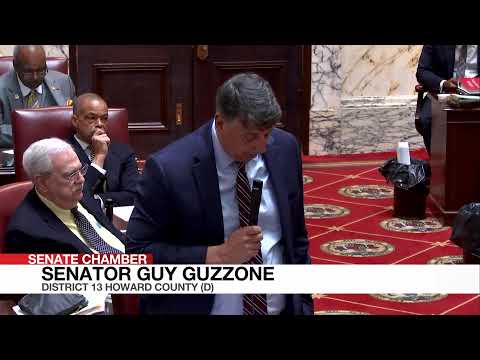
The Maryland Senate spent much of its Jan. 29 floor session debating Senate Bill 1, a measure that directs the Maryland Police Training and Standards Commission (MPTSC) to adopt a uniform statewide policy governing when law-enforcement officers may wear masks while performing duties in Maryland and imposes a civil citation—up to $1,500—for violations. The Judicial Proceedings Committee’s floor leader presented the bill and moved adoption of a favorable committee report and two committee amendments; the amended report was approved and Senate Bill 1 was ordered printed for third reading.
Supporters said the bill aims to preserve public safety and trust by limiting situations in which officers—including those operating in Maryland from other jurisdictions—may hide their identities. “Masks undermine that trust and that transparency,” the floor leader said while describing exceptions the commission will write for health, safety, inclement weather and undercover operations.
Opponents pressed the bill’s practical and legal implications, focusing on whether Maryland could effectively enforce a state standard against federal agents and how enforcement would play out on the street. The senator from Frederick County described a hypothetical in which a local officer approaches a masked federal agent to issue a civil citation, asking, “Is that not correct?” The floor leader said officers retain enforcement discretion and noted the MPTSC will craft exceptions and protocols.
A central line of argument concerned the supremacy clause and litigation risk. Senators asked whether the attorney general had provided a clear opinion on whether the law could be applied to federal agents; the floor leader said the AG’s conclusion was inconclusive and noted similar measures in other states have prompted litigation. “We don’t know the answer to that case because the prosecution refused to prosecute for other reasons,” he said of precedent cited during debate, adding that the question “has not been fully litigated.”
Lawmakers offered several floor amendments addressing enforcement mechanics and consequences. One amendment would have required a local law‑enforcement agency that has probable cause an officer (for example an ICE agent) violated the section to notify the attorney general so the state could bring an injunction; senators debated AG capacity and whether that approach would avoid street confrontations. That amendment failed on the roll call, with 30 votes in the negative.
Other offered amendments sought to lower the maximum civil penalty, clarify exceptions for inclement weather and undercover assignments, and protect officers’ home addresses from publication; each was debated and voted on during the session, and several were defeated. Committee amendments—technical and to make MPTSC policy preempt local, inconsistent masking policies—were adopted earlier by unanimous consent.
The floor leader emphasized the MPTSC will develop the operational rules and exceptions, and that nothing in the bill as amended creates criminal penalties; it creates a civil citation and preserves administrative accountability under the Maryland Police Accountability Act for covered officers. He also said the bill includes an affirmative defense for an officer exercising discretion in evaluating a situation.
The Senate did not vote to pass the bill into law; rather, after the floor’s debate and roll‑call consideration of amendments, Senate Bill 1 was ordered printed for third reading, the procedural step before a later vote on final passage. Several senators warned litigation is likely if the statute is enacted and that federal court challenges—citing cases referenced on the floor—could determine whether or how the measure applies to federal law-enforcement officers.
What happens next: The bill will be printed for third reading and may return to the floor with additional amendments or votes. If enacted, the MPTSC will be responsible for writing the details of the uniform policy and the exceptions that legislators said are central to the bill’s real‑world operation.