
FPDR board adopts $353 million FY 2026–27 budget, sets $17M contingency
Get AI-powered insights, summaries, and transcripts
Sign Up Free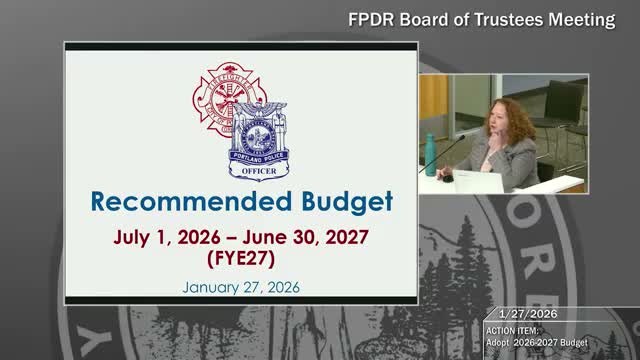
Summary
The Fire & Police Disability & Retirement board unanimously adopted the staff‑recommended FY 2026–27 budget, citing rising pension and PERS costs, a projected surge of retirements in May, and a $17 million contingency to manage forecast risks.
The Fire & Police Disability & Retirement (FPDR) Board of Trustees voted to adopt the staff‑recommended FY 2026–27 budget on Jan. 30, approving the spending plan and five‑year forecast that staff said totals about $353,000,000 for the coming fiscal year.
Stacy, FPDR finance staff, told trustees the recommended budget reflects a 9.6% increase in total fund expenditures driven primarily by pension payments and rising PERS contributions. "That's $353,000,000 next year," she said, pointing to the slide with year‑over‑year comparisons and a five‑year forecast.
The budget package includes a $17 million fund contingency (about 6–6.5% of expenditures) to cover unexpected costs and revenue shortfalls. Stacy said the contingency is sized to help the bureau absorb near‑term shocks and to avoid violating local budget law if a major spending category is exceeded.
Trustees spent significant time on two near‑term risks highlighted by staff: an expected surge of retirements tied to the May payroll cycle and the citywide outlook for property tax revenue. Staff budgeted for 72 retirements in the May cycle but cautioned the actual number could be higher; "if we see that in May, it's possible we would ask you to amend the budget," Stacy said. She told trustees she would grow concerned only in an extreme scenario of roughly 110 retirements.
On revenues, staff said more than 98% of FPDR resources come from property taxes and that the levy will need to increase by roughly 11% next fiscal year to meet obligations, partly because of elevated compression and delinquency losses that staff expect to persist over the near term.
The board discussed actuarial assumptions and advisory PERS rates included in the forecast. Stacy said Milliman's advisory rates show contribution rates stable in the next biennium at about 38.1%, which would save roughly $63.4 million over four years if realized; she cautioned, however, that advisory rates could change when actual rates are set. "They're advisory rates — that means advisory," she said.
Trustees also reviewed program‑level details: FPDR 1 and 2 pension payments are expected to grow about 7.3% next year (driven by COLAs and expected retiree profiles), administrative spending is budgeted at about $5.8 million (up ~6%), and the budget includes funds to fill a vacant disability analyst position.
After discussion the board moved, seconded and approved the budget by voice and roll call; the motion carried, and trustees asked staff to return with any necessary technical amendments after police and fire bureau budgets are finalized.
The board left open the option of amending the budget if actual retirements or other forecast changes materialize before the fiscal year begins.