Get Full Government Meeting Transcripts, Videos, & Alerts Forever!
Get email alerts on the Municipal Budget topic
No spam. Unsubscribe anytime.
Tenino council gives first reading to 2025 budget as leaders flag loan repayment and tight revenues
Summary
Council held the first public hearing and first reading of the city's proposed 2025 budget, highlighting a $735,000 carryover (interfund loan), planned debt service on an $1.8 million loan and conservative revenue assumptions; council asked staff for quarterly reviews and clearer bank-account reporting.
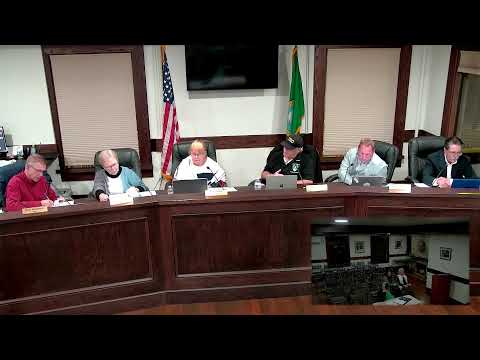
Tenino council members held a first reading and public hearing on the proposed 2025 budget on Nov. 12, as staff described constrained revenues and a significant loan repayment schedule.
During the work session and public hearing, staff explained that an interfund borrowing makes the starting carryover appear larger; they estimated a $735,000 carryover but cautioned that much of that reflects borrowed funds rather than available operating reserves. "So $624,000 of that is paying back that loan," an unidentified staff presenter said when explaining how loan repayment appears in the expenditure lines.
The draft budget assumes the city will carry and repay an $1.8 million total loan across multiple years, including a newly discussed $500,000 addition. Staff said about $600,000 of the proposed 2025 expenditures are repayment and interest (presenter cited $624,000 including roughly $24,000 of interest). Members debated whether to treat the loan as part of operating revenue or use it strictly as a temporary buffer. One council member urged caution: "First rule of, finding yourself in the hole is to stop digging," arguing the city should stop deficit spending regardless of loan accounting.
Revenue assumptions in the draft were intentionally conservative, staff said. Key revenue drivers discussed included property tax projections (personal property), sales and use taxes, and new or expanded miscellaneous revenue lines, among them lease income from the Ag Park (projected roughly $36,000 from the North building and $10,000 from the South). Staff also flagged that building permit receipts and some intergovernmental revenues came in lower than previously budgeted.
Council members requested clearer, more frequent reporting so they can monitor bank balances and cash flow. Staff proposed quarterly budget reviews and a midyear adjustment process; several members recommended tighter real-time account reporting to spot shortfalls sooner. The council confirmed the next step: holding a second reading and final adoption at the next regular meeting, with opportunities for additional amendments before final approval.
The hearing included a staff presentation on revenue methodology, which relied on contract-fixed revenues, agency projections, historical averaging, and judgment where the data varied significantly. The public was invited to comment; no members of the public offered testimony on the revenue portion during the hearing.
What happens next: the budget will return for a second reading and final adoption at the next regular meeting; council members asked staff to provide quarterly financial updates and to prepare recommended cuts or alternative revenue options for the next meeting.