
Agency of Digital Services seeks $96.5M for FY27, shifts to service-based budget to reduce duplication
Get AI-powered insights, summaries, and transcripts
Subscribe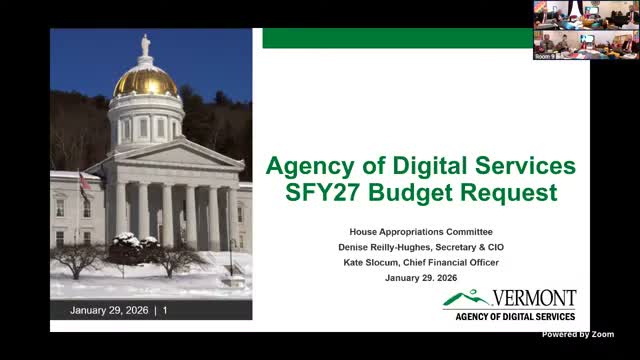
Summary
The Agency of Digital Services told the House Appropriations Committee it is requesting about $96.5 million for FY27 and is shifting to a service-based model that moves more functions into a Core Enterprise Services allocation, introduces three internal service funds and includes a $9 million general-fund recommendation to lower agency chargeback rates.
The Agency of Digital Services (ADS) asked the House Appropriations Committee on Jan. 29 for about $96.5 million to support its FY27 operations and outlined a structural shift to a service-based budgeting model that leaders say will reduce duplicate contracting and make costs more predictable.
Denise Matthews, ADS secretary and chief information officer, said the agency is emphasizing four strategic priorities — user experience, standards, predictability and simplification — and has restructured leadership and its portfolio to support a new Core Enterprise Services (CES) model. “We are asking for 96 and a half million dollars in total to support the agency,” the chair recited from the ADS presentation slides during the hearing.
Why it matters: ADS officials said the new model is intended to improve transparency about who uses services and to align billing more closely with consumption. ADS reported it has identified more than $50 million in cumulative savings since 2017, including about $5 million validated last calendar year, largely from consolidating network infrastructure and contracts.
Under the proposal, the agency would present two appropriations: one for CES (foundational platforms such as desktop, network and cybersecurity services) and another for demand-driven services divided into three internal service funds (ISFs) covering SLA-type shared services, timesheet/professional services (project and embedded staff billing) and customized or agency‑specific procurement ("spoke" services). ADS leaders said finance and management recommended that some costs now borne by agencies be recognized as general fund within ADS; the FY27 budget includes a $9 million general-fund recommendation intended to cover about a quarter of CES costs and reduce per-user rates for state agencies.
ADS officials told the committee the chargeback model has historically under‑recovered the true cost of provision in timesheet billing. Kate Slocom, ADS chief financial officer, said the agency is exploring moving more services into the CES allocation so the per-agency cost is predictable and so agencies can budget for core services rather than being exposed to variable timesheet charges.
On transition funding, ADS explained a prior one‑time $15 million appropriation was used to avoid agencies being charged twice during the move to CES and that the investment had helped reduce demand; the agency expects to show CES as a general-fund–supported allocation in FY27 to ease the shift. “That 15, the one‑time, netted the results that we were looking for,” an ADS presenter said in the discussion.
What remains unresolved: Committee members pressed for more granular numbers comparing FY26 and FY27, and ADS agreed to provide links and line-item detail. Members also asked finance and management to attend a future hearing to explain how the $9 million general‑fund recommendation was calculated and how the shift will be neutral or not for the general fund overall.
The committee did not take formal action on the ADS request during the session; ADS staff said they will supply additional budget breakdowns to the committee and that the pathway forward on rates rests with Finance and Management.