Get Full Government Meeting Transcripts, Videos, & Alerts Forever!
Get email alerts on the Emergency Response topic
No spam. Unsubscribe anytime.
Nashville officials outline response as historic ice storm leaves roughly 135,000 without power
Summary
Mayor Freddy O'Connell and city leaders briefed the public on restoration efforts after a historic ice storm, reporting about 135,000 customers still without power, expanded crew mutual aid, active warming centers and guidance on water-system risks and safety.
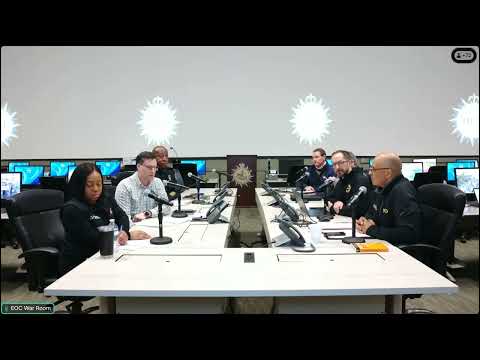
At a virtual briefing from the Metro Nashville Emergency Operations Center, Mayor Freddy O'Connell and city emergency officials provided an update on response and public guidance after a historic ice storm left large parts of the city without power. Officials described restoration progress, sheltering and safety guidance for residents.
The briefing centered on restoring electricity and protecting vulnerable residents. Mayor Freddy O'Connell said the outage was "a historic ice storm," and officials described it as the largest single outage in NES history. Brent Baker, NES chief of operations and innovation, said NES had restored about 100,000 customers since the storm while roughly 135,000 customers remained without power. "We doubled our workforce after the first day," Baker said, adding the utility expected more than 900 line workers to be on site by nightfall and that crews from several states were aiding restoration through mutual-aid arrangements.
Officials emphasized sheltering and transportation. The city reported about 439 people accessed warming locations overnight at sites including the Nashville Fairgrounds, the Madison Community Center and the Southeast Community Center; Metro departments and partner nonprofits are operating additional shelter capacity for people experiencing homelessness (city officials said partners were providing shelter for nearly 1,400 people each night). Mayor O'Connell said the city activated a transportation hotline for residents needing a ride to warming centers; Patrice Coleman, acting director of the Department of Emergency Communications, said the hotline is staffed by DEC and requested callers use it only for shelter-transport requests. The city gave the hotline number for shelter transportation as (615) 401-1712 and provided WeGo transit information at (615) 844-3399.
Metro Water Services Director Scott Potter warned that thawing ground and changed demand create a higher risk of main breaks and advised residents to let faucets drip overnight to reduce freeze risk. Potter gave an operational example: 100 gallons of water including sewer and taxes costs about $1.70, and a slow drip (a "pencil lead thin stream") will typically use about 40 gallons in 24 hours, a far smaller expense than major pipe repairs. He also named three areas the department was watching for leaks: Oak Hill, the Jolten area, and Love Circle.
Public safety officials said emergency services remain available. Chief John Drake of the Metro Nashville Police Department said call volume surged during the event but had declined from an earlier peak; he reported two potential storm-related deaths that had been communicated by the medical examiner's office but said the causes of death remained unknown. Drake urged residents to treat downed power lines as live and to treat nonworking signals as four-way stops.
City leaders asked residents to leave road space for emergency and utility crews and to document storm damage. O'Connell said the city is coordinating with state and federal partners and will evaluate an emergency declaration that is in effect for up to seven days. Officials said updates will be posted repeatedly on nashville.gov and on department social channels.
The briefing closed with a reminder that officials will continue to post frequent updates and to coordinate sheltering, mutual aid and road and vegetation recovery in the coming days.