Get Full Government Meeting Transcripts, Videos, & Alerts Forever!
Get email alerts on the Land Use topic
No spam. Unsubscribe anytime.
City staff reports modest annexation and a development pipeline driven by nonresidential projects
Summary
City planning staff reported a small annexation (0.06 sq mi) and forecasted hundreds of new lots in coming months, with nonresidential projects such as a Walmart distribution center and MTSU-related work powering most near-term growth.
Tom, a city planning presenter, told the workshop that 'this year, we had a little bit of growth in terms of annexation. 0.06 square miles added to the city,' and said the city's annual growth rate aligns with retail strategy estimates at about 1.7%.
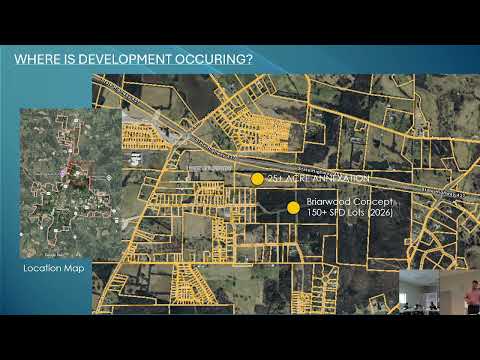
The presentation outlined current and planned subdivisions and plats. Staff said final plats produced roughly 164 lots in the past year and that concept- and final-plat activity could yield about 500 lots in the next few months. Major projects mentioned included a Walmart distribution center, MTSU institutional work, a proposed Briarwood single-family development of about 150 lots, a Victory Park townhome proposal of roughly 150 units and a Cedar Glade HUD project of 48 townhomes. Tom also noted a recently approved PUD change that removed 39 townhome units and converted them to commercial lots.
Staff emphasized code and definition changes as a prerequisite for shaping future development patterns. Tom said the city’s current zoning appendix generalizes many uses and that revising definitions and supplemental regulations would allow the city to limit certain uses in core areas and raise the overall value of commercial corridors. He said the planning commission will begin a series of workshops in the spring to review sub-regulations and the zoning ordinance.
Tom described the bypass corridor as a primary area for mixed higher-density residential and commercial growth and said a TDOT-coordinated bypass connection will require about a 14-month right-of-way process. He urged that the city take stepwise code updates — starting with definitions and buffering guidance — to achieve a longer-term land-use table revision.
Next steps: staff will present draft definition changes and graphics in advance of planning-commission workshops this spring and accept public comment during that process.