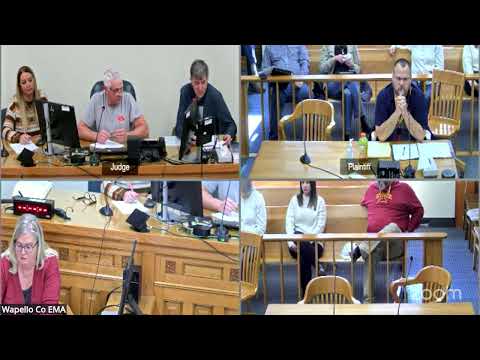
Board members warn proposed state property-tax changes could 'devastate' small towns
Loading...
Summary
Board members discussed recent governor and legislative property-tax proposals — including a 2% cap, a $25,000 residential exemption and a 10% carryover provision — and expressed concern those measures could sharply reduce county revenue and hinder long-term capital projects.
At the meeting, Speaker 1 raised detailed concerns about recent state proposals to restrict property-tax growth and expand exemptions, saying the governor’s plan in particular could be harmful to small towns.
"It would be devastating to small towns," Speaker 1 said, summarizing features they said were in the governor’s proposal: an annual 2% growth cap, a $25,000 residential exemption, and a 10% carryover limit for budgets. Speaker 1 described a county-assessor test on a small town that suggested a $25,000 exemption could remove roughly $5 million of taxable value from a jurisdiction with about $9.8 million in taxable valuation, and warned those changes could impede budgeting for multi-year projects such as bridges or a new 911 tower.
Board members discussed differences among the governor’s proposal, the house plan and the senate bill. Speaker 1 said the senate bill ties increases to the Consumer Price Index and eliminates the rollback; other proposals were described as capping growth at 2% plus new construction. Speakers noted that new construction in many cities can be placed under urban-revitalization or exemption programs and therefore may not generate immediate additional taxable value for cities or counties.
"If you can only carry over 10%, how do you save for anything?" Speaker 1 asked, noting the difficulty of setting aside funds for long-term projects if carryover is restricted.
Board members did not take a formal vote or adopt a position on the state proposals during the meeting; they exchanged descriptive analysis and concerns and directed staff to gather information on a separate local tax-reduction request for a future agenda.
Because the transcript records budget and valuation examples offered by Speaker 1 and mentions an assessor’s informal test, the article does not assert final fiscal calculations; it reports the board members’ concerns and the examples presented during discussion.