Lifetime Citizen Portal Access — AI Briefings, Alerts & Unlimited Follows
Measure U advisory panel reviews prototype dashboard as commissioners press for clearer metrics and cost measures
Loading...
Summary
City staff showed a first-quarter Measure U dashboard covering July–Sept 2025. Commissioners praised the design but pressed for clearer metric definitions, program-level FTE and financial breakdowns, and cost-per-encounter calculations; staff said the tool is a prototype and will be refined.
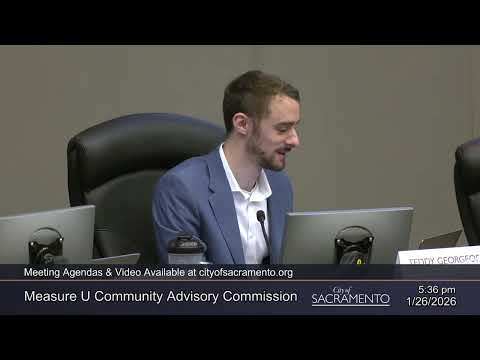
City staff presented a prototype Measure U metrics dashboard to the Measure U Community Advisory Committee on Jan. 26, outlining program- and department-level spending and performance data for the period July 1–Sept. 30, 2025.
Ash, a city staff member managing the dashboard, said the tool uses "progressive disclosure" so users can drill from department totals into program-level metrics. He told commissioners the dashboard now adopts the city council's priorities—economic development, public safety and homelessness—labeling them as "categories" rather than the commission's earlier "priorities." "This dashboard is a working prototype for feedback and review. All data and information presented are preliminary and subject to change," Ash said.
The dashboard displayed $39,600,000 in Measure U-related funding spread across categories: about $25,500,000 for community response and roughly $14,100,000 for homelessness (staff identified those as the two largest category groupings shown on the screen). Ash demonstrated program details, including the Office of Community Outreach (reported as roughly $3.7 million in program value and an authorized 25 FTEs) and a first-quarter value of 20,663 cases opened during the reporting window.
Commissioners welcomed the interface but asked for clarifications about units, definitions and how to make the dashboard meaningful for residents and policy decisions. "If I go to this website, a normal person doesn't drill into it. They just say, 'Oh, Measure U is spending $14 million on homelessness,'" Commissioner Cook said, urging staff to surface aggregate measures that explain how category and program values relate.
Cook pressed for a way to estimate the "cost per encounter"—for example, dividing a category budget by a program metric to produce a per-unit cost. Ash cautioned that a simple division risks misleading results unless program boundaries, overlapping services, and outside funding (including state grants) are accounted for. "We have to also account for all of these other metrics and there may be other programs that are specifically addressing those objectives," Ash said, noting that state funding and grant offsets complicate a straightforward per-unit calculation.
Commissioners also flagged missing metric definitions and inconsistent calculations of "FTE as a percent of budget." Ash acknowledged gaps in metric descriptions and said some metric frequencies (quarterly vs. weekly) differ by program; he pointed commissioners to a weekly homelessness dashboard (homeless.safesacramento.org) for more granular case-open/close counts and to inform future improvements.
The commission asked staff to provide: clearer labels for "value" and units; a glossary of metric definitions; program-level metrics in addition to department-level aggregates; and options for showing open versus closed cases. Staff agreed to gather the feedback, to refine metric definitions with the new city manager's performance framework, and to bring an updated dashboard to a future meeting.
The broader goal, commissioners said, is to convert the new interface into a tool that supports budget recommendations and public outreach. "The goal here was to get feedback," Ash said, adding that staff will continue to refine the dashboard based on commissioner input and additional quarterly data.