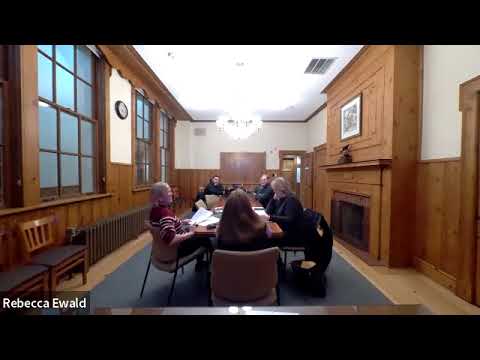
Shorewood committee debates DPW service levels, recycling and a proposed facility study
Loading...
Summary
The Strategic Initiatives Committee discussed an itemized DPW service list and debated a proposed $150,000 facility/service-level study. Trustees weighed outsourcing vs. in-house services, in-house recycling, transfer-station feasibility and composting pilots; the committee opted to report the discussion to the Village Board without recommending a full study at this time.
The Strategic Initiatives Committee spent the bulk of its meeting reviewing a service-level listing drawn from a 2020 study and debating next steps for the Department of Public Works (DPW), including whether to commission a separate facility and service-level study estimated in discussion at roughly $150,000. Trustees did not authorize a full study at this time; instead the committee agreed to provide a summary of the discussion to the full Village Board without recommending that the board commission the study immediately.
Staff framed the exercise as a way to distinguish core statutory services (public health and safety) from discretionary "quality-of-life" services such as business-district plantings, beach grooming and urban forestry. On plantings, staff said business-district organizations have historically contributed modest sums to winter greenery—"between $1,000 and $1,500" in recent years—while trustees proposed exploring larger private contributions to offset village costs.
Staff clarified that DPW beach work focuses on sand grooming and removal of hazards rather than routine litter pickup. On urban forestry, staff emphasized both the visibility and liability of tree work: "Tree removal is big liability," staff said, noting pruning and planting decisions affect budgets and risk. Trustees discussed stump grinding, contract tradeoffs and where discretionary cuts could fall.
Operational concerns included vehicle and shop capacity and the shift from two mechanics to one with outsourced repairs. Staff said a properly equipped shop with lifts improves efficiency but recruiting and retaining qualified mechanics remains challenging. Trustees considered whether a new yard or facility could change staffing needs.
The committee also took up larger service-delivery questions: whether to pursue joint-service arrangements with neighboring communities, or to bring recycling in-house if a transfer station were available. Staff estimated annual recycling operational costs at about $350,000 (excluding trucks and transfer-station capital), and recommended a full financial analysis before making an insourcing decision. On composting, staff and trustees discussed pilot drop-off options and partnerships with organizations such as Compost Crusaders and local schools; staff cited roughly 300–400 households participating in a subscription compost program as a baseline for potential expansion.
Trustees debated whether to proceed immediately with a proposed $150k study (some discussion placed the figure as high as $175k) but several members argued to defer, saying service-level changes are unlikely without major investments and that existing studies provide much of the needed analysis. The committee voted to provide a summary of the conversation to the full Village Board without recommending commissioning the full service-level RFP/study at this time. Any decision to fund a study, build a new yard, or change service levels will require future board action and detailed financial analysis.