Get Full Government Meeting Transcripts, Videos, & Alerts Forever!
Get email alerts on the Budget topic
No spam. Unsubscribe anytime.
Chino Valley council holds budget workshop as staff seeks direction on cuts, priorities and timing
Summary
At a Feb. budget workshop, Chino Valley staff presented survey results and fiscal pressures — including no town property tax and reliance on transaction privilege tax (TPT) — and asked council whether operating budgets should stay flat or be cut (1%–3% scenarios). Staff set April study sessions and tentative budget adoption in May and final adoption in June; no formal votes were taken.
Chino Valley held a budget workshop focused on fiscal priorities and a tentative schedule for the coming budget cycle. Town staff told council the town lacks an ad valorem property tax and depends heavily on transaction privilege tax (TPT) and one-time construction revenues, leaving it vulnerable to state legislative changes and to shifts in statewide population growth that affect shared revenues.
Staff outlined the process and timeline: departments must submit final requests in the next two weeks, staff will hold multiple study sessions in April, present a tentative budget in May and aim for final adoption in June. Staff emphasized the distinction between ongoing operating costs and one-time capital requests, and asked council to indicate whether operating budgets should be held flat or reduced in modest increments (examples discussed: 1% or 3% decreases). Staff warned that even small percentage cuts compound and reduce purchasing power when inflation is considered.
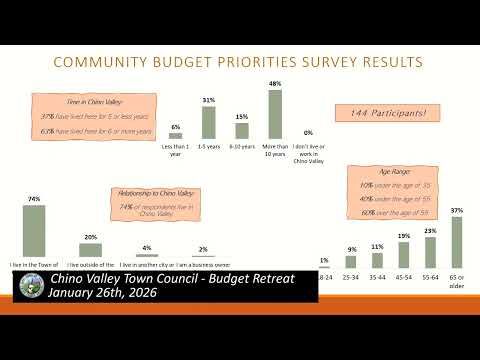
A staff summary of the town’s community survey — 144 respondents, 74% of whom live in Chino Valley and 60% aged 55 or older — showed top public concerns: business retention/retail (notably grocery options), street repairs, and protection of local water resources. Council members cited the senior center, public safety and library services among valued services that residents want preserved.
Council members debated trade-offs between “tightening the valve” on operating budgets and the risk of deferred maintenance. Several members urged prioritizing economic development to increase the town’s ongoing revenue base. Staff noted upcoming items that could change revenue projections, including retail projects and housing developments that will affect state-shared revenue and construction tax receipts.
The workshop closed with staff committing to present dollarized scenarios and follow-up analysis at the April study sessions so council can choose how to balance operating budget direction, one-time investments and capital priorities.
The council did not take formal votes during the workshop; staff will return with figures and specific budget proposals at the scheduled study sessions.