Staff recommend Recology for Renton’s next solid waste contract, citing outreach and stronger performance protections
Loading...
Summary
City staff told the Committee of the Whole they prefer awarding a 10‑year contract to Recology beginning in 2027 to improve outreach, support compliance with a new state organics management law, and add enforceable performance fees; projected customer rate impacts are higher than extending Republic but staff say value is greater.
Mira Hubach, the city’s solid waste program manager, told the Committee of the Whole that staff recommend contracting with Recology to provide Renton’s solid waste services beginning in 2027, saying the company scored highest in a competitive evaluation and offers stronger outreach and enforceable performance provisions.
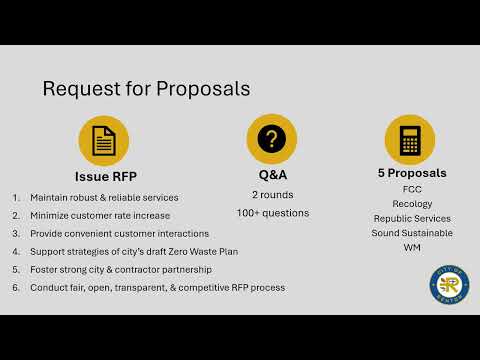
Hubach said the city received five responsive proposals after publishing an RFP in June and that Recology received the top score — 91.9 out of 100 — after a process that included proposal reviews, 11 site visits, 13 reference checks and interviews. “Recology scored the highest with 91.9 out of a 100 points,” she said, and staff negotiated a subsequent reduction in Recology’s proposed annual prices during contracting discussions.
Why it matters: Hubach said a new contract is an opportunity to align service with the state’s recently passed organics management law and Renton’s near‑final zero‑waste plan. She told council the law aims to reduce landfill methane and standardize cart colors, and that the next contractor will be relied on to help commercial customers begin required food‑waste separation.
Staff also detailed problems under the current 10‑year contract with Republic Services awarded in 2017. Hubach said Republic repeatedly failed to meet contract outreach requirements — reporting less than 5% of required multifamily outreach and under 8% of required commercial outreach in some years — and that community contributions promised early in the contract largely ceased in the last five years. She cited slow responses to city requests, delays in issuing customer credits after missed collections, and strike‑related service disruptions (2019: two days; 2022: four days; 2025: 12 days). Hubach told the committee that “in mid August, the city invoiced Republic … $270,000 in performance fees,” and the city is awaiting corporate approval on the remaining balance.
What Recology would change: Hubach listed operational and customer‑service improvements Recology proposes, including Sunday call‑center hours, two full‑time outreach staff dedicated to Renton, expanded curbside special‑item recycling (textiles and small electronics collected at no cost), a return to city billing, harmonized and new or reconditioned single‑family carts to meet state color standards, temporary collection sites that can be activated after three days of disruption, and contractual mechanisms to automatically deduct performance fees from contractor invoices. She also highlighted environmental steps, including options to acquire electric collection vehicles early in the contract term.
Rates and tradeoffs: Staff presented two rate scenarios for 2027. Extending with Republic was projected to increase overall contractor revenue by about 4.8%; contracting with Recology was projected to increase contractor revenue by about 8.6% (staff noted contractor revenue is only part of how customer rates are set by the city). Hubach said the projected 2027 increase tied to Recology represents “incredible value” relative to recent regional procurements and that a final rate proposal will return to council later in the year.
Council questions and staff responses: Councilmembers pressed staff on how the city will ensure Recology follows through after promises, given the prior contract’s shortcomings. Councilmember Rivera asked how the city can avoid repeating past problems; Hubach pointed to Recology’s strong references (she said she contacted Issaquah and Tukwila) and to specific contract changes: added performance fees, operational plans, and roughly 60 contract modifications designed to create enforceable consequences where past language was insufficient. Staff said Recology has added local capacity, including an operations yard in Maltby and extra shifts at a recycling facility, and that the company committed to dedicate two outreach staff solely to Renton.
Labor and risk notes: Hubach said the city has not communicated directly with Republic’s union during this procurement. She added that Recology has not experienced driver strikes and that its regional footprint reduces the risk that an out‑of‑region labor action would disrupt Renton service.
Next steps: Hubach said negotiations are near complete after 10 meetings and staff plan to bring the contract to council in February. At that meeting council will have the option to approve the Recology contract as recommended, extend Republic’s contract, or reject proposals and reissue the RFP. Hubach closed by saying staff are confident Recology can help Renton meet state requirements and support the city’s zero‑waste strategy.
The Committee of the Whole did not take a formal vote at the meeting; the contract decision will come to council in a future session.