Douglas County staff propose in‑house K–8 truancy program, ‘Everyday Counts’
Get AI-powered insights, summaries, and transcripts
SubscribeSummary
Douglas County staff proposed a three‑tier, case‑management truancy program for K–8 students called Everyday Counts that would centralize referrals to the District Attorney’s office and add a juvenile services officer; commissioners asked for clearer school district buy‑in, data tracking and consideration of access barriers.
Douglas County staff on Jan. 28 presented a proposal to move elementary and middle‑school truancy services from an external contractor into an in‑house criminal justice services program called Everyday Counts.
Katie Fitzgerald, the county’s criminal justice coordinator, told commissioners the proposal grows out of last year’s budget decisions: “You all set aside the $150,000 that previously had been allocated to CSC,” and staff later recommended part of that money continue to CSC through December while retaining $87,500 for the remainder of 2026 as the county develops an alternative model. Assistant Director Lee Hausman and juvenile services staff described a three‑tier model intended to provide earlier, more direct case management for children who meet statutory truancy thresholds.
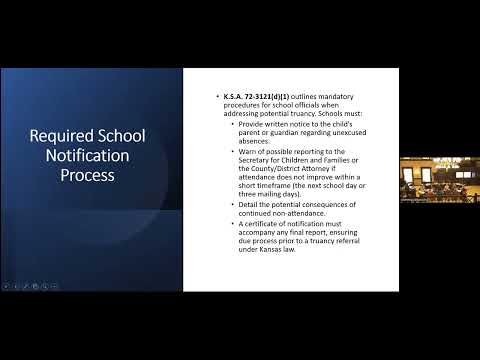
Under the plan, schools would continue to follow Kansas compulsory attendance rules (the so‑called 3‑5‑7 rule). As one presenter summarized, “In Kansas, a child is considered truant if they have at least 1 unexcused absence on 3 consecutive days, 5 unexcused absences in a semester, or 7 unexcused days in a year.” When that threshold is reached, schools are required to issue a warning letter and, if attendance does not improve, file the official 10‑06 documentation that triggers review by the Douglas County District Attorney’s Office and CJS truancy staff.
Everyday Counts is organized as: tier 1 (universal, voluntary case management that meets families at school to identify barriers such as transportation, housing or mental‑health needs and to offer incentives); tier 2 (a neighborhood truancy board facilitated by Building Peace to engage families and community volunteers); and tier 3 (court involvement when families decline services or referrals indicate more intensive intervention, including possible child‑in‑need‑of‑care petitions).
Lee Hausman described tier 1 expectations and supports: if a family agrees to participate, staff will review a program contract and “our program expectations are for the youth to attend 8 weeks of school with no unexcused absences.” Presenters said schools’ principals retain authority to determine whether specific absences are excused; CJS staff would coordinate with school records staff when monitoring program compliance.
Prosecutors and CJS staff flagged data and reporting limits. A member of the district attorney’s office said the number of formal referrals is small relative to the number of students who may meet the statutory threshold, noting, “I think what you all are picking up on is that it’s wildly underreported to us.” Commissioners pressed staff to track how long truancy patterns exist before referrals reach the DA’s office and to document what interventions schools had already attempted.
Budget and staffing questions were central to the discussion. Staff proposed using a Kansas Department of Corrections prevention grant to partially cover neighborhood‑truancy‑board costs and requested funding for an additional juvenile services officer to replace some functions previously carried out by volunteers. Staff described FY26 as a half year (the latter semester) with FY27 carrying full‑year costs; the proposal includes line items for salary, fringe, incentives and barrier reductions but staff described some figures as guesstimates.
Commissioners expressed several concerns: whether the county model duplicates existing restorative practices in Lawrence Public Schools; whether having county staff instead of volunteers improves or reduces individualized support; and whether the program will be valuable enough to district partners to merit adoption. One commissioner urged the county to bring school district officials to a future conversation so commissioners could hear directly about districts’ needs and current interventions.
If the commission approves the proposal, staff said next steps would include hiring and onboarding a juvenile services officer during the summer, establishing a school engagement plan and data fields to track referral timing and prior interventions, and returning recommended business agenda items for formal approval at a future meeting. The work session closed with no action taken.