
Brevard tourism board freezes capital grant awards, orders county attorneys to tighten rules
Get AI-powered insights, summaries, and transcripts
Subscribe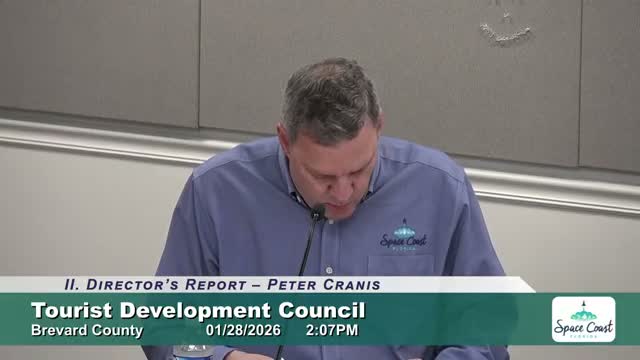
Summary
The Brevard County Tourism Development Council unanimously voted to pause consideration of capital facilities grant applications for the current and next fiscal years and directed the county attorney to refine eligibility and clawback language in proposed guidelines.
The Brevard County Tourism Development Council voted unanimously to halt consideration of capital facilities grant applications for the current and next fiscal years and directed county attorneys to continue drafting stricter grant-language intended to better protect public funds.
At the meeting, Tom Hermanson moved that the TDC "not consider capital grant funding requests for the current or next fiscal years," a motion Mayor Connors seconded; a roll-call vote recorded unanimous approval by Mayor Connors, Vice Chair Hermanson, Alex Littrick, John Moran, Wayne Sword and Chair Feltner.
Peter, a TDC staff member who presented the item, told the board he had prepared a 10-year projection showing about $650,000 available this fiscal year and that, under current assumptions (including upcoming reimbursements for projects such as the lighthouse and amphitheater), the fund balance could be just under $1,000,000 — a level staff said is "not ideal for an award of a grant this year." He also flagged a contingent long-term line tied to an aquarium project and noted Brightline has sought federal grant funds; staff said the TDC is also holding $5,000,000 reserved for Brightline.
Staff proposed three key guideline changes the board discussed: limit eligible reimbursements to actual construction (hard costs) and remove pre-construction costs such as architectural and engineering work from eligibility; require the TDC to be the last funding source (applicants must secure other financing first and request TDC reimbursement at project completion); and add a clawback provision so reimbursed funds could be reclaimed if a project stalled or failed to complete. Peter said the clawback language remains under review by the county attorney's office.
Board members asked legal and practical questions about enforcement. Justin (county/legal staff referenced in discussion) and others said enforcement could be contractual rather than a recorded lien; the board directed the county attorney to draft enforceable language that balances protection of public funds with financing realities, noting that some financing structures (for example, bank financing) and lack of personal guarantees can complicate clawbacks.
Several members argued the current fund balance was too small to support meaningful capital awards and urged reserving funds for larger-impact projects. Vice Chair Hermanson said the TDC has a "horrible track record of approving everything that comes before this board" and recommended pausing awards until a substantial fund balance accrues; the board adopted that approach by unanimous vote.
The board also approved a separate motion directing staff and the county attorney's office to continue developing the revised draft guidelines (expanding the list of eligible construction costs, refining clawback terms and considering financing implications) and to return with a final draft for TDC review. Chair Feltner confirmed the matter will return to the TDC for further discussion, and members agreed the subcommittee structure can be decided at a later meeting if needed.
The TDC recorded no public comments on the item at this meeting. The board is scheduled to reconvene on Feb. 25, when members can review the county attorney's draft and discuss whether to convene a subcommittee to vet applications and final language.
Ending: The motion to pause capital grants and the direction to the county attorney were adopted unanimously; staff will return with a revised draft and possible subcommittee options at a future meeting.