Get Full Government Meeting Transcripts, Videos, & Alerts Forever!
Get email alerts on the Open Meetings Public Records topic
No spam. Unsubscribe anytime.
Ketchikan Gateway Borough school board gets legal briefing on Open Meetings, public records and social media risks
Summary
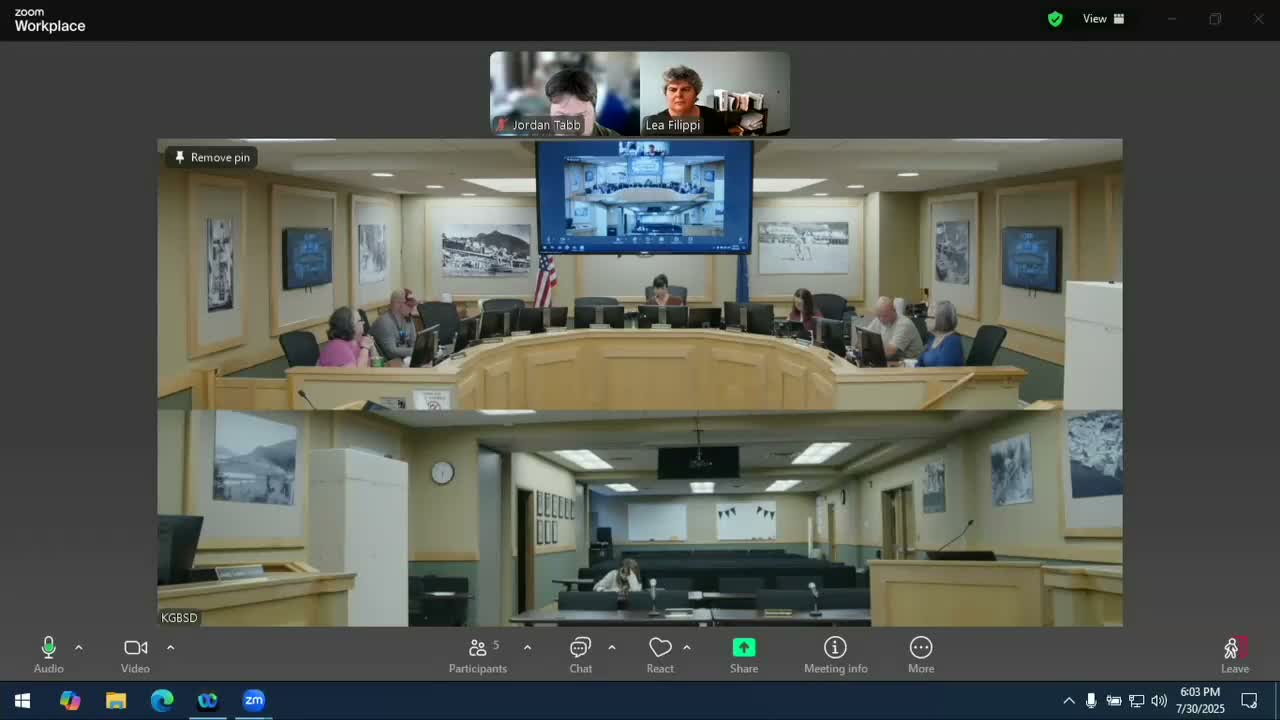
At a July 30 special meeting the Ketchikan Gateway Borough School District board held a work session legal training led by Anchorage attorney Leah Philippi on the Open Meetings Act, the Public Records Act, adjudicatory duties (nonretention, dismissals, expulsions), and how personal social media can become public records. The board approved the agenda and entered the work session; no policy votes were taken.
Leah Philippi, an attorney with Cedar, Wendland, Evans, and Philippi in Anchorage, told the Ketchikan Gateway Borough School District Board of Education on July 30 that Alaska law sets both the board's baseline duties and limits on how members may act outside of noticed meetings.
"One of the things that you all have in common is that you are all creatures of the same set of statutes," Philippi said, describing statutes that assign boards responsibilities such as adopting the budget, setting the school calendar and keeping records. She told members the statutes also create specific adjudicatory duties the board must perform, including reviewing nonretention decisions, teacher-dismissal challenges and certain student-discipline cases.
Philippi walked the board through the Open Meetings Act and the Public Records Act, stressing common compliance pitfalls: gatherings of three or more members that discuss board business can create an appearance of an unlawful meeting; substantive phone polling, email chains or coordinated social-media exchanges can amount to deliberation outside an open forum; and personal accounts can become subject to public-records requests if used substantially for official purposes.
"Try to refrain from commenting on each other's social media posts about political hot topics that relate to the Board," Philippi advised, noting courts consider how an account is used when deciding whether private messages or posts are public records. She cited the well-known example of litigation over former governor Sarah Palin's emails to illustrate how personal communications can be captured in litigation and records requests if they document official business.
On the question of committees and advisory bodies, Philippi recommended continuing to notice committee meetings and to provide public access (in-person or virtual) so the committee's work is clearly open and documented. She also recommended the board review administrative regulations that create appellate routes to the board—such as AR 13 30 (facilities-use appeals) and AR 4,144 (employee concerns)—and consider whether some processes should be elevated into board policy to control how much time appeals use on the board agenda.
During a question-and-answer exchange, Philippi described indemnification practice and litigation strategy, and said that individual board members are more likely to face legal exposure when there is a record of personal, outside-the-board activity tied to contested decisions. She urged the board to adopt clear bylaws where the board wishes to set firm operational constraints, and otherwise to rely on the superintendent to administer day-to-day operations.
The board first approved the meeting agenda by roll call and then voted to enter the legal-training work session. The president introduced Philippi and the training ran through general counsel guidance, statutory references, case examples and audience questions. The board moved out of the work session and adjourned at 7:11 p.m.; no formal policy actions or new regulations were adopted during the special meeting.
Votes at a glance: The board approved the July 30 agenda by roll-call vote (Robbins Jr., Ginter, Thomas, Guthrie, Tam, Reed, Tatsuta recorded as voting in favor). The subsequent motion to enter the legal-training work session passed by roll call.