Get Full Government Meeting Transcripts, Videos, & Alerts Forever!
Get email alerts on the School Finance topic
No spam. Unsubscribe anytime.
Ketchikan officials press school district on $5.4 million health‑insurance liability, weigh repayment timetables
Summary
Assembly and school board liaison members reviewed preliminary cash‑flow projections Jan. 27, discussed a $5,400,000 health‑insurance liability identified in recent audits, and debated three‑ and five‑year repayment scenarios while scheduling follow‑up work and a March 3 meeting.
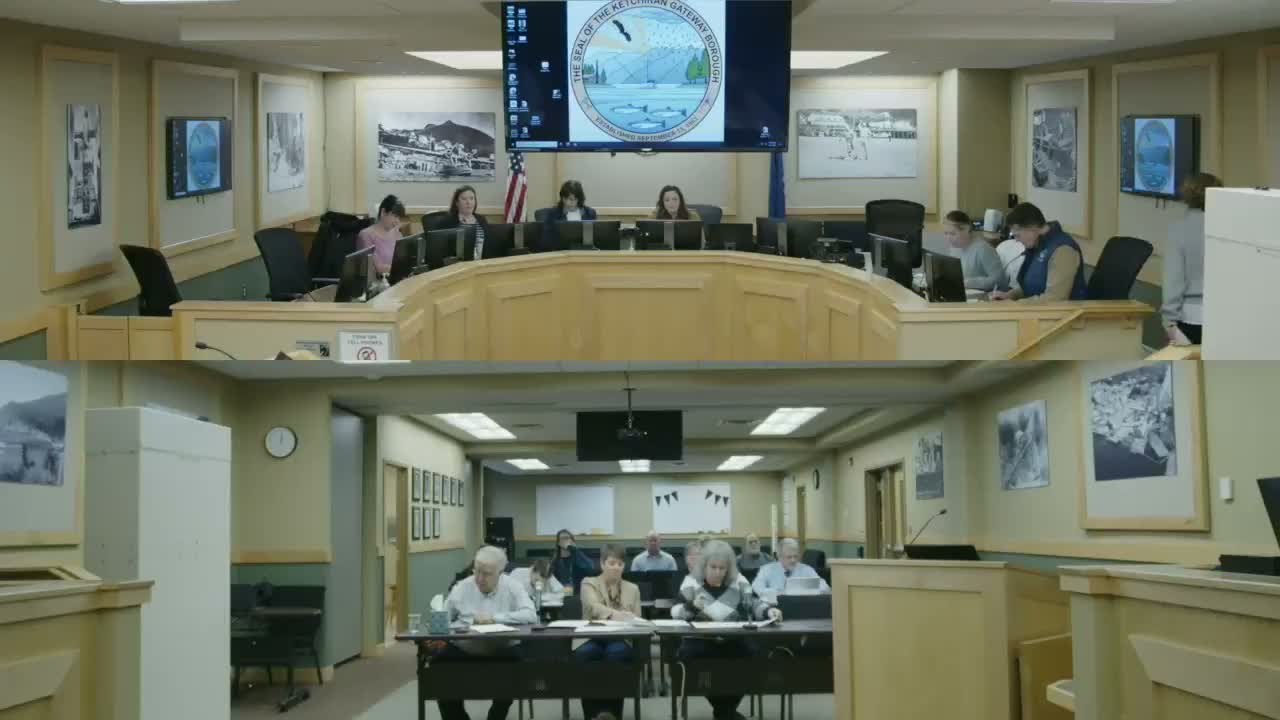
KETCHIKAN, Alaska — Members of the Ketchikan Gateway Borough Assembly and the School Board’s liaison committee met Jan. 27 to review preliminary school district cash‑flow projections and address a roughly $5,400,000 liability tied to health‑insurance claims and premiums that auditors flagged in recent reports.
Lisa Pierce, the district’s consultant business manager, told the committee she had only arrived in Ketchikan the prior evening and had been able to produce an initial cash‑flow spreadsheet but had not yet pulled full historical outflows from district software. “I just honestly have not had that opportunity to even realistically give you anything that’s even worth looking at, to be honest with you,” Pierce said, describing the materials as a starting point that staff would expand as they gathered more data.
Assembly members and school board representatives pressed staff for clearer assumptions. The packet presented a starting general‑fund balance identified in the spreadsheet as $8,700,000 and included historical claim assumptions (one figure on prior materials was $149,005.30 per maritime claim run). Staff and committee members also discussed monthly payroll runs the presentation listed at roughly $2.3 million–$2.4 million and the district’s expected state foundation receipts, noting one more month of the previously calculated $2.34 million payment and an anticipated roughly $10 million in state foundation receipts over the projection window.
Assembly member Dowell raised concerns that, given the district’s burn rate and the sequestering of funds by the borough, the district could face a cash shortfall later in the spring if inflows or access to district funds did not materialize. “The prior business manager indicated there that the district was gonna face a cash shortage problem by the end of the fiscal year, and that was not including the $5,400,000 that the borough has encumbered,” Dowell said.
Manager Duran, representing borough staff, said auditors reported the amount as a short‑term payable and that the borough holds the amount in cash, creating a fiduciary bind. “I have a payable that’s in front of me. I have… cash that’s associated with that payable,” Duran said, adding that elected bodies must resolve whether the amount is treated as a short‑term obligation or converted into a longer‑term arrangement through an agreement between governing bodies.
Committee members discussed two repayment scenarios staff had modeled. The prior policy presentation included a five‑year payback proposal of $1,000,000 per year; staff were asked to model a three‑year schedule, which produced an estimated payment of roughly $1,800,000 per year and required reducing discretionary local contributions to keep the borough’s minimum cash floor intact. Finance staff warned that the MOA, if produced, would include interest and other terms not yet reflected in the working spreadsheet.
School board members and the superintendent said they were confronting significant uncertainty — turnover in leadership and pending collective‑bargaining negotiations (named parties included KEA, KLO and IBEW in the discussion) — and requested more time to assemble contract and enrollment data before committing to a repayment schedule. “We are going to get flat funding from the state,” Superintendent Bullard said, adding that the district’s projected costs and contract outcomes would determine a realistic repayment timetable.
No formal agreement was reached at the Jan. 27 meeting. Committee members agreed to continue the liaison discussions, requested a fuller cash‑flow model with historical outflows and clearer accrual detail, and scheduled a follow‑up meeting for March 3 at 12:00 p.m. hosted by the school district.
The liaison committee also acknowledged several audit figures staff said they would verify and incorporate into updated projections, including an accounts‑payable accrual shown in the audit at about $930,000, a payroll accrual in the high‑hundreds of thousands, and an identified claims run‑out number spoken of in prior materials near $1,300,000. Staff said they would clarify which items auditors had classified as short‑term payables versus long‑term liabilities and would reflect interest assumptions in any proposed MOA.