Get Full Government Meeting Transcripts, Videos, & Alerts Forever!
Get email alerts on the Board Governance topic
No spam. Unsubscribe anytime.
Portland School Board holds governance workshop on standards, trust and meeting processes
Summary
Consultants Sandy Hayes and Amy led a governance workshop with Portland Public Schools board members and Superintendent Dr. Armstrong. The board discussed OSBA/Washington standards, accountability as alignment (not punishment), committee/agenda processes, staffing capacity amid multi‑year cuts, and short-term steps to triage board requests.
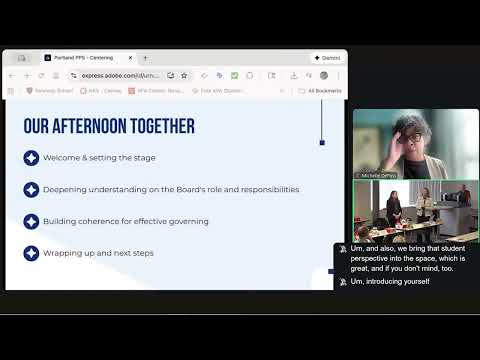
Consultants Sandy Hayes and Amy led a full‑day governance workshop with Portland Public Schools board members and Superintendent Dr. Armstrong focused on how board practice connects to student outcomes and trust in district leadership. The session reviewed state board‑standards material and produced a set of immediate next steps on email triage, committee charters and policy review.
The facilitators opened by grounding the conversation in practice: Sandy Hayes described her experience working with districts of many sizes and noted the scope of the task, saying, “We have over 20,000 students hovering right around 21, 22,000, depending on the day.” The workshop used the Oregon School Boards Association/Washington standards and a research summary called “the science of student achievement” to prompt reflection about which board practices most strongly correlate with improved student performance.
Why it matters: board governance choices shape the district’s capacity to support classrooms and staff. Several board members said the board and district have strengths—vision‑directed planning, financial administration and community engagement—but they flagged three interlocking concerns: how the board handles information and questions, how committee work is chartered, and whether central office staffing is sufficient as budget reductions continue.
On accountability, board member Eddie Wong urged a constructive framing: “What is productive accountability? It’s exactly what it says right here, which is the board sets high expectations for student learning, hold[s] the organization accountable for achieving results,” and most importantly aligns policy and resources to strategic goals rather than treating accountability as punishment. That definition framed much of the workshop’s conversation about how to set priorities and assess results.
Superintendent Dr. Armstrong said the district is using 2025–26 as a bridge year while staff and the leadership team pursue a renewed vision through 2030; she asked the board to help align any new strategic priorities with realistic timelines and staffing. Board members repeatedly raised concerns that three years of budget cuts and fewer central‑office staff will reduce the district’s ability to respond to ad‑hoc requests and to support committee follow‑up. As Michelle put it, the board is “really concerned about capacity — organizational capacity, individual and staff capacity.”
Several participants focused on process. Members described long board meetings driven by large bond and facilities work and proposed clearer rules of engagement so staff can triage and prioritize requests. Facilitators and staff proposed a short‑term triage protocol for board email (subject‑line tagging that clarifies whether an item is an agenda request, committee follow‑up, or a community question and copying the superintendent’s office and Roseanne) and asked the policy committee to circulate Section 1 policies (committee charters and meeting types) so all board members share a common baseline.
The group also discussed curriculum adoption and how board policy interacts with staff‑led pilots and community engagement. A staff and board exchange clarified that the local curriculum process includes pilot classrooms, student and teacher input, community review and a staff recommendation that comes to the board for approval; a speaker referenced Division 22’s five‑year expectation for curriculum review as a compliance anchor.
Facilitators closed by introducing a five‑facet trust framework (benevolence, honesty, openness, reliability and competence) and asked the board to use trust‑building as a lens for governance work. Short‑term commitments included circulating committee charters and agenda‑setting notes, piloting a rotation or sign‑up for agenda‑planning participation, and implementing the email triage protocol while the policy committee evaluates whether broader structural changes (meeting cadence, committee scope) are needed.
The board left with an agreed set of next steps rather than final decisions: the district will resend materials and the self‑assessment tool and the policy committee will continue work on Section 1; facilitators and staff will return for follow‑up sessions. That combined approach — immediate operational fixes plus longer policy review — was framed as a way to protect staff bandwidth while aligning board work more tightly with student outcomes.