King County TDR manager briefs Clark County Planning Commission on land-conservation tool
Loading...
Summary
Nick Bratton, manager of King County's transfer of development rights program, told the Clark County Planning Commission on Jan. 29 that King County's TDR efforts have conserved more than 148,000 acres and mobilized roughly $60 million from the private market while directing development into urban areas; he outlined program mechanics, success factors and options for Clark County.
Nick Bratton, manager of King County’s Transfer of Development Rights (TDR) program, briefed the Clark County Planning Commission on Jan. 29 about how TDRs work and how they have been used in King County to conserve rural land and concentrate growth in urban areas.
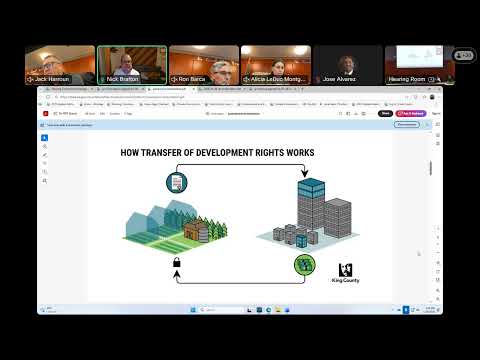
Bratton said TDR programs let landowners in designated 'sending' areas sell development rights to developers who want to add height or density in 'receiving' areas. "That credit can then be purchased by a developer in an urban area who may then use that credit to build higher intensity," Bratton said. He described the conservation outcome as permanent, implemented by conservation easements while landowners retain farming and timber rights.
The presentation emphasized practical results and program design. Bratton told commissioners that over 25 years King County’s program has protected more than 148,000 acres across about 200 properties and supported roughly 140 projects; he reported a total market value of about $60,000,000 transacted through TDRs. "That's $60,000,000 in private funding that's come into the program, that we have not had to spend of taxpayer dollars to achieve 148,000 acres of conservation," he said.
Bratton outlined the key ingredients for a functioning TDR market: sufficient supply of enrolled landowners, demand from developers where growth opportunity exists, feasible economics for both sellers and buyers, program simplicity and facilitation by a public agency, policy alignment so incentives meet market demand, and sustained political will to adapt the program over time.
He described operational approaches King County uses: a private-market exchange where buyers and sellers can list credits, and a King County TDR Bank that purchases credits up front and holds inventory so developers can buy without assembling many individual transactions. Bratton said interlocal agreements with partner cities and a revenue-sharing arrangement also help create demand and fund local infrastructure needs.
Commissioner Haroun asked whether Clark County could adopt a TDR variant focused on permanently conserving agricultural land rather than an incentive-based revenue model. Bratton said King County maintains a separate "4 to 1" mechanism for removing one acre from a resource designation while conserving four acres elsewhere, and clarified that the standard King County TDR program is distinct from that approach. He also explained that developers can either assemble credits on the private market or buy from the county bank: "We also have the King County TDR Bank in which the county has purchased the development rights upfront, and then we hold those in an inventory that developers can then buy from us," he said.
Bratton offered examples ranging from large downtown projects that used TDR to gain multiple stories of height (he cited Rainier Square Tower) to small, local subdivisions that added units by purchasing a handful of rights, conserving features such as a Girl Scout camp along the Tolt River. He closed by offering to continue supporting Clark County staff with follow-up questions.
The planning commission took no formal action at the work session. The chair said the commission would reconvene at 6:30 p.m. for a hearing on preferred alternative tables and then adjourned the work session.