
State labs refine methods to distinguish hemp from marijuana after 2018 Farm Bill
Get AI-powered insights, summaries, and transcripts
Sign Up Free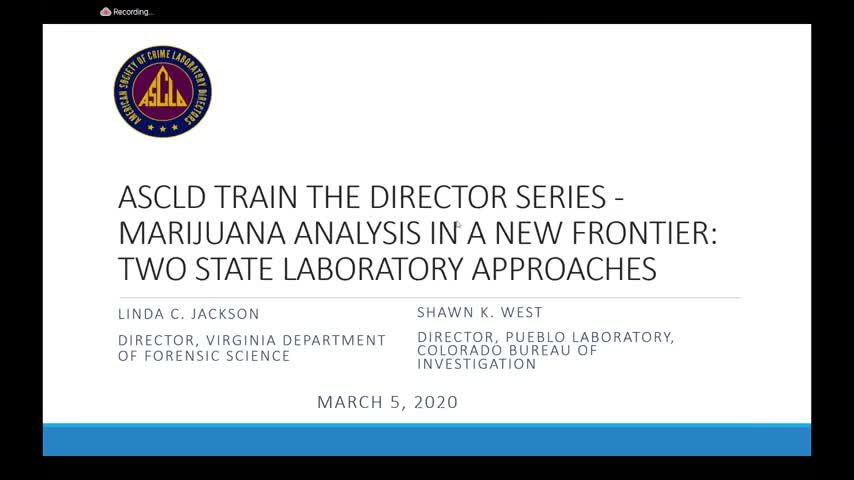
Summary
At an RTI webinar, Virginia and Colorado forensic lab leaders described how the 2018 Farm Bill and evolving USDA guidance prompted new testing approaches: Virginia validated field kits and set administrative screening thresholds; Colorado adopted semi‑quantitative GCMS/FID schemes and HPLC quantitation for plant material.
At a national webinar hosted by RTI International, Linda Jackson, director of the Virginia Department of Forensic Sciences, and Sean West, Pueblo laboratory director for the Colorado Bureau of Investigation, described how state forensic laboratories have changed methods to separate industrial hemp from marijuana after the 2018 Farm Bill.
The Farm Bill and federal guidance on hemp forced laboratories and prosecutors to reconcile regulatory and criminal testing. "The Farm Bill...establish[ed] a regulatory framework for the commercial production of hemp," Jackson said, and the federal definition sets hemp as cannabis with a delta‑9 tetrahydrocannabinol concentration "of not more than 0.3% on a dry weight basis." That threshold, and subsequent USDA guidance about ‘‘total THC’’ (which includes converted THCA), has led states to adjust lab practice so regulatory and criminal determinations are consistent.
Why it matters: measurement method and reporting determine whether seized plant material is treated as contraband or an agricultural product. That distinction affects whether cases are prosecuted, how evidence is reported to prosecutors and defense counsel, and what tools law enforcement should use in the field.
Virginia approach: affirmative defense, 4‑AP validation and outreach Virginia placed regulatory authority for hemp with its agriculture agency and preserved an affirmative‑defense code provision that treats cannabis as marijuana unless in the possession of a licensed grower, with the burden of proof on the defendant. Jackson said that after the 2018 Farm Bill the Commonwealth amended law (effective March 2019 under an emergency clause) to exclude industrial hemp and hemp products from the statutory definition of marijuana and that an agency bill was used to clarify laboratory authority to determine appropriate methods.
Because of widespread market availability of labeled CBD/hemp products and smokeable "hemp flower," Virginia validated a colorimetric field reagent known as the 4‑AP test in collaboration with the DEA Special Testing Laboratory and civilian public‑health labs. Jackson noted the state used interlaboratory samples and agricultural controls, produced user memos and a training video, and—using grant funds secured through the state Department of Criminal Justice Services—distributed about 16,000 field kits to law enforcement across the Commonwealth. She cautioned that the 4‑AP kit is a ratio‑based screen that "indicates a material that is THC rich or that is CBD rich and it works on the ratio of those 2 compounds," and does not measure THC concentration.
Colorado approach: semi‑quant screening and HPLC quantification West said Colorado has long dealt with medical and recreational markets and that the state chose to implement laboratory quantitation for plant samples. The Colorado Bureau of Investigation purchased HPLC with diode‑array detection in mid‑2018, validated a quant method and placed it into service on Jan. 1, 2019 for plant material. The lab uses GCMS and GC‑FID screening and a semi‑quantitative FID peak‑area ratio method for rapid classification; for specimens needing precise concentration the HPLC quant is used.
Of roughly 20 plant items quantified in 2019, West reported two measured below 0.1%, 12 fell between about 0.1% and 10%, and six were above 10%. He said the lab reports a relative uncertainty (example shown in slides) and uses reporting conventions such as "greater than 10%" when the result exceeds the validated linear range. On screening, Colorado labs implemented a daily QC standard and decision point (example: if the morning standard yields a ratio of 2.14, that value becomes the day's threshold). If the screening ratio meets or exceeds the administrative threshold (Colorado uses a ratio approach tied to their validated QC), the item is reported as marijuana; if below, it is reported as "cannabis, not determined" with guidance on when a full quantitative resubmission is appropriate.
Field limitations and non‑plant matrices Both speakers emphasized limits: the 4‑AP kit and similar color tests do not quantify THC and can yield false positives with some plant materials; thin‑layer chromatography (TLC) and other screens remain useful for examiner triage. Neither state yet has broadly validated quantitative extractions for many consumer matrices—body creams, edibles, certain extracts and vape cartridges—and those materials are often reported as "presence of cannabinoids" or "cannabis, not determined" unless a validated quantitative method exists.
Quotes and prosecution implications "We actually had some agencies call us and say, what does this mean?" West said of new report language after moving to semi‑quant reporting, underscoring the need for outreach to prosecutors and police. Jackson stressed that aligning regulatory testing and criminal reporting reduces confusion in the field and in court.
What comes next Both jurisdictions continue method refinement, interagency outreach and additional validation for other matrices. Labs encourage law enforcement and prosecutors to coordinate with forensic labs early so cases are routed to the correct analytical path and so reporting language is understood by legal partners.
The webinar slides, SOP references and training materials were made available by the presenters; the session recording and slide deck are archived by the host.