
Laboratories and industry face measurement, sampling and stability hurdles as hemp market expands
Get AI-powered insights, summaries, and transcripts
Subscribe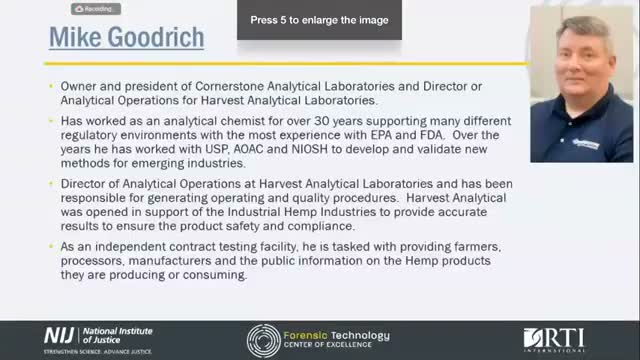
Summary
Private‑sector testing leaders described analytical, sampling and stability problems for hemp products, including matrix effects, certificate‑of‑analysis misuse, decarboxylation uncertainties and the need for accredited labs.
Mike Goodrich, owner and president of Cornerstone Analytical and director of analytical operations for Harvest Analytical Laboratories, described operational challenges laboratories and farmers face as commercial hemp production grows.
Goodrich emphasized the importance of representative sampling and transparent certificates of analysis (COAs). "They're terrified of having their investment loss due to a bad test from a state lab coming out and then losing their entire facility," he said, noting farmers routinely test in the field but face varying state standards, matrix complexity and inconsistent lab quality.
He explained how processes that concentrate CBD can also concentrate THC, causing distillates and isolates to exceed regulatory limits if manufacturers do not control formulation. Goodrich also reviewed decarboxylation chemistry and how method choice (HPLC vs GC‑FID/GC‑MS), extraction solvent, moisture correction and incomplete decarboxylation can change measured THC values.
Goodrich warned about common problems in the marketplace: reused or "bootleg" COAs, lack of shelf‑life/stability data for stored crop material, and heterogenous product matrices (edibles, gummies, salves) that complicate extraction and quantitation. He recommended labs pursue method validation, ISO accreditation and careful selection of limits of quantitation to reduce disputes.
Why it matters: growers and manufacturers rely on testing to certify compliance and protect crop value; inconsistent testing and uncontrolled matrices can lead to crop loss, shipment refusals, or enforcement action.
What remains unresolved: interstate transport standards, how carriers handle concentrated products, and differences between state approaches to sample unit and weight calculations for enforcement.
Next step: presenters offered to post HPLC methods and other resources; FTCOE will distribute slide decks and consider a follow‑up webinar to address open operational questions.