
DEA outlines new forensic scheme: color test plus rapid GC‑MS for THC decision limits
Get AI-powered insights, summaries, and transcripts
Sign Up Free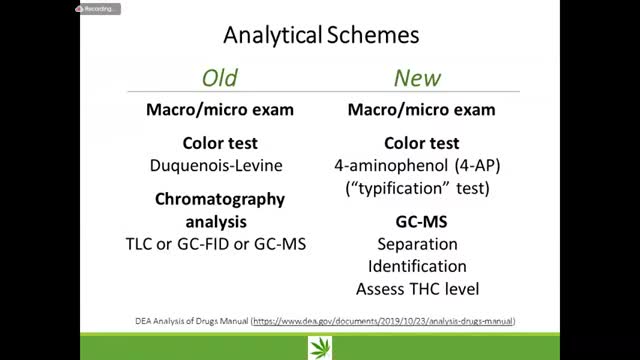
Summary
The DEA Special Testing and Research Laboratory described a validated two‑part forensic approach — a typification (4‑aminophenol) color test and a rapid GC‑MS decision limit tied to an internal standard — and set reporting rules for 'marijuana' versus 'inconclusive.'
Dr. Sandra Rodriguez Cruz, a senior research chemist at the Drug Enforcement Administration’s Special Testing and Research Laboratory, described a revised analytical scheme her laboratory implemented in 2019 to distinguish hemp from marijuana in federal casework.
"For the first time, we actually are in the position where in order to make a qualitative identification of a particular controlled substance, we actually need to ... quantitate the level of a particular compound," Rodriguez Cruz said, explaining why the 2018 Farm Bill forced method changes in federal forensic labs.
The DEA’s approach combines three layers of analysis for plant material: microscopic examination, a typification color test (4‑aminophenol) that indicates whether the THC:CBD ratio is above or below 1, and a 5.3‑minute GC‑MS method that uses an internal standard marker calibrated to a 1% total‑THC decision limit (operationalized as a 0.05 mg/mL internal standard concentration for extracted samples).
Rodriguez Cruz summarized validation results from 36 Virginia samples tested repeatedly: the color test reliably distinguished THC‑dominant (blue) from CBD‑dominant (pink) material outside an identified "inconclusive" ratio region. The DEA team found mixed or inconclusive color results are expected when THC:CBD ratios fall roughly between 0.3 and 3, so the laboratory treats those outcomes as inconclusive unless corroborated by other tests.
On reporting, Rodriguez Cruz said the DEA treats a unit as marijuana only when three corroborating results are positive — microscopic characteristics, a blue typification color test, and a GC‑MS THC‑to‑internal‑standard ratio above the decision marker. "Any other scenario ... is reported as inconclusive, and the customer is given the option of request[ing] further analysis," she said.
Why it matters: forensic reporting rules determine how seized material is characterized for prosecution and disposition. The DEA’s method aims for a fast, instrument‑compatible approach that can be transferred across regional laboratories while acknowledging analytical uncertainty in intermediate ratio ranges.
What remains unresolved: the inconclusive zone and matrix interferences, the handling of extracts and processed products (where the color test can be unreliable), and how state laboratory practices and court rules will adopt or adapt the DEA’s decision limits.
Next step: the DEA piloted the method at its Dallas regional laboratory and transferred it to other regional labs; federal labs now implement the scheme for plant material and have a separate SOP for liquids and extracts.