Experts say USDA 'total THC' rule and FDA policies leave legal status of CBD products unclear
Loading...
Summary
Panelists told an RTI webinar that while the 2018 farm bill defined hemp by delta‑9 THC (0.3% dry weight), USDA rulemaking adopting 'total THC' and FDA's ongoing review of CBD have created regulatory uncertainty affecting industry, carriers, and law enforcement.
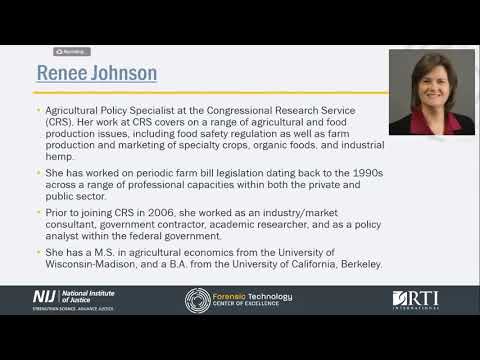
Speakers at an RTI Forensic Technology Center of Excellence webinar described a regulatory gray area created by differences between statutory language, agency rulemaking and enforcement. Renee Johnson of the Congressional Research Service noted that Congress defined hemp as cannabis sativa with a delta‑9 THC concentration of not more than 0.3% on a dry‑weight basis, but said USDA’s rulemaking and earlier agency statements introduced the concept of “total THC” (the post‑decarboxylation sum of THC and THCA) and that this has prompted thousands of public comments and industry concern.
"Congress defined it to mean the plant… with a delta‑9 THC concentration of not more than 0.3 on the dry weight basis," Johnson said, adding that USDA’s regulatory framework and earlier DEA/USDA statements raised the total‑THC issue and that industry groups like the Hemp Industries Association have litigated or commented on the interpretation.
Panelists discussed practical consequences: interstate traceability problems (a crop certified as hemp in one state could be illegal if transported across a state line with a different interpretation), carrier policies (FedEx restrictions vs. USPS guidance), and the fact that FDA retains authority over food and consumer products containing cannabinoids under 7 U.S.C. 1639r, including an open FDA docket reviewing scientific data and comments for policy guidance.
Mike Goodrich, a private‑sector laboratory director, described operational impacts on testing, shipping and labeling. He said many states have adopted their own limits, and modern market and import dynamics (including imports from Canada) complicate simple estimates of domestic production and sales. The panel recommended labs and producers follow USDA, state rules and FDA guidance where relevant, and noted that industry will likely adapt cultivation and testing to meet total‑THC compliance if that becomes the prevailing standard.
What happens next: USDA rulemaking remains open to comments; industry and laboratories are watching for final rule language and potential congressional clarifications.