Deputy Chief Medical Examiner Urges Standardized Investigations, Shows Autopsy Evidence in 'Death in Custody' Cases
Loading...
Summary
Dr. Francisco Diaz, deputy chief medical examiner for Washington, D.C., urged standardized definitions, enhanced autopsy techniques and careful next-of-kin notification in deaths in custody, and illustrated the point with a case involving TASER use and severe coronary artery disease.
Dr. Francisco Diaz, deputy chief medical examiner for Washington, D.C., told an online audience that the United States lacks a uniform definition or consistent investigative standards for deaths that occur while people are under law-enforcement control and urged practitioners to adopt consensus autopsy and reporting practices.
Diaz said the causes of deaths in custody mirror causes in the general population — chronic disease, suicide and drug toxicity — but that some deaths arise during apprehension, transport or confinement. "A percentage of people who die in custody died of natural causes," he said, adding that others die from suicide, drug-related causes or events during the process of apprehension.
The context: Why it matters. Diaz described a multi-jurisdictional position paper produced by a committee convened by the National Association of Medical Examiners to recommend consistent investigative and autopsy practices for custody-related deaths. He said the paper — a short set of guidelines on autopsy technique, scene investigation, photography and postmortem toxicology — will be distributed to attendees by RTI. "Those are guidelines, suggestions by the National Association of Medical Examiners," he said.
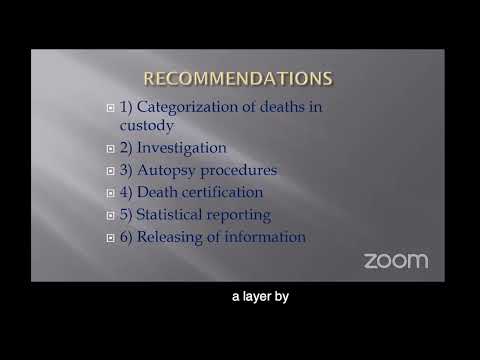
Key recommendations and practices. Diaz recommended that medical examiners and coroners: - Adopt a working categorization for deaths in custody that covers precustody events (perceived restraint or pursuit), transportation, incarceration in jails or prisons, juvenile secure facilities and contracted facilities; - Treat investigation as equally important to autopsy, including retrospective scene visits when warranted; and - Use enhanced autopsy dissections in custody cases (layer-by-layer neck dissection, focused dissections beneath restraint contact points such as handcuffs) and systematic documentation, including checkboxes to track custody deaths for statistics.
On release of records and family notification, Diaz emphasized jurisdictional variation: some states (he cited Michigan) are open-records jurisdictions where autopsy reports can be obtained publicly, while others (he said Washington, D.C.) restrict autopsy reports to next of kin, law enforcement, or attorneys. He said officials should inform next of kin before releasing details to the public in high-profile cases.
Law and reporting. Diaz pointed to the federal framework, noting that "in the year 2013, Congress enacted the Death in Custody Reporting Act," which he described as broadly covering deaths of detained or arrested persons in municipal, county, state, or contracted facilities and during encounters with law enforcement. He framed consistent definitions and reporting as necessary to fulfill that statutory intent.
Case examples and evidence. To illustrate investigative detail, Diaz reviewed photographs and autopsy findings from a case of a 57-year-old man who fled officers after an encounter and sustained facial abrasions consistent with a "terminal fall." He also reviewed dissection photos showing where TASER (electro-muscular disruptor) probes contacted the chest and said the probes "only goes a little bit underneath the subcutaneous tissue," a point he stressed should be documented during autopsy rather than assumed to produce deep, knife-like wounds.
Diaz contrasted those restraint- or device-related findings with his autopsy finding of severe coronary disease: he showed dissections of the three main coronary arteries and said the arteries showed near-complete obstruction, an underlying medical explanation for the death despite the custody encounter.
What was not decided. The webinar presented recommended practices and a proposed working definition; it did not establish binding policy or change statutory law. Diaz framed these as consensus guidelines and urged jurisdictions and practitioners to adopt the recommendations.
Next steps. Attendees were told copies of the NAME position paper would be distributed; Diaz encouraged practitioners to read it and to consider implementing the investigative and autopsy standards discussed.