Get Full Government Meeting Transcripts, Videos, & Alerts Forever!
Get email alerts on the Housing Policy topic
No spam. Unsubscribe anytime.
NH COG trainers outline HB8002 changes: regional housing plans, middle housing rules and new parking standards
Summary
At an NH COG training, presenter Jocelyn Ayers summarized HB8002 (Public Act discussed in-session) and told local planning and zoning volunteers that COGs must create regional housing growth plans by June 1, 2028; certain zoning changes (middle housing, parking) take effect July 1; 8-30g procedures and fair-housing duties were also reviewed.
Jocelyn Ayers, the session presenter, told attendees of the Northwest Hills Council of Governments that the state law discussed in the briefing will require new regional planning and immediate zoning adjustments in some areas. "As of July 1, your regulations, shall allow the development of ... middle housing developments, which is defined as between 2 and 9 units," Ayers said, describing changes that will affect commercial and mixed‑use zones and give towns limited options to retain special‑permit requirements.
The training, moderated by NH COG staff and opened by Sarah Vetter of NH COG, focused on two primary parts of the measure: a multi‑year regional planning timeline and a set of zoning changes that apply sooner. Ayers said councils of governments must create a regional housing growth plan or member municipalities must adopt plans of their own; she called out a June 1, 2028 deadline for COG plans and said OPM (the Office of Policy and Management) is expected to issue implementation guidance and mapping tools before regional and statewide targets are published later in 2026.
Why it matters: the rules change what local zoning may permit or prohibit. Ayers emphasized that under the state's zoning enabling framework commissioners must not adopt rules that effectively bar multifamily or middle‑housing types and that denying applications for reasons such as "the character of the town" or a project's financial viability can create legal exposure. She explained the state's affordable‑housing appeals statute, 8‑30g, and urged commissioners to consider local options—overlay districts, incentive housing zones, adaptive reuse rules—that other Litchfield County towns have used to create modest, well‑designed housing.
Key details from the session: • Planning timeline: Ayers said the statute gives time for compliance but requires either regional housing growth plans prepared by COGs or municipal plans; she cited a June 1, 2028 due date for COG plans and a December 2026 milestone when statewide/regional targets will be published. • Zoning changes: zoning provisions that take effect July 1 will require commercial and mixed‑use zones to allow "middle housing" (2–9 units) as‑of‑right (subject to site plan or administrative review rather than special permits). Ayers said some towns may opt to allow middle housing in residential zones to earn procedural benefits related to 8‑30g moratoria. • Parking: attendees were told that parking rules shift for small developments; on or about July 1 (the presenter cited 07/01/2026 for related parking provisions), towns generally cannot deny residential developments of 15 units or fewer solely for failing to meet minimum parking standards. Towns may create targeted districts (conservation or traffic‑mitigation districts) to retain parking minimums or adopt fee‑in‑lieu rules for larger projects (16+ units). • 8‑30g and inventory: Ayers reviewed the appeals process and the state inventory definitions—government‑assisted units, deed‑restricted units, units with rental assistance and subsidized USDA mortgages count toward a town's affordable inventory. She noted Torrington was the only Northwest Hills COG municipality reported to meet the 10% threshold; many towns cited are near 1–2%.
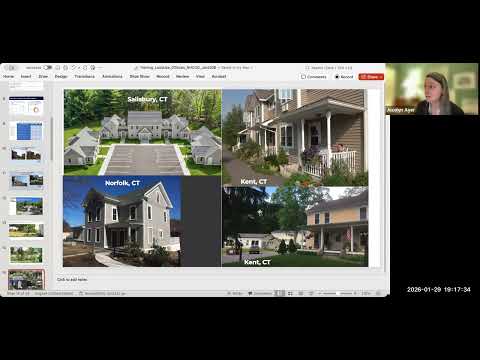
Ayers used regional examples to show how small projects can fit into town character: rehabilitated farmhouses, 8‑unit homeownership projects with conserved open space and solar, and 10–18 unit senior or multifamily projects in several Litchfield County towns. She also stressed fair‑housing obligations, saying those rules apply to all housing and that municipal policies should identify and remove impediments to fair housing choice.
During Q&A attendees pressed on practical topics. On whether commissions should weigh a project's financial viability, Ayers said that feasibility is primarily the developer's responsibility and that gap financing—local philanthropy, CHFA and state housing funds—typically makes homeownership or rental projects viable. "That's kind of the developer's problem," she said when describing financial‑feasibility limits on what planning bodies may lawfully consider. On use of conserved or donated land, Ayers highlighted existing examples where land trusts and housing nonprofits coordinate—sometimes transferring parcels more suitable for housing to affordable‑housing organizations while conserving adjacent acreage.
Ayers and NH COG staff encouraged attendees to participate in upcoming outreach, offered follow‑up materials and technical assistance, and provided links to resources including the Department of Housing guidance, Partnership for Strong Communities summaries, and local housing trust examples. The session ended with organizers asking attendees to submit contact details for attendance credit and promising additional trainings as needed.
What comes next: NH COG will be part of the regional planning work and outreach ahead of the June 2028 plan deadline; OPM guidance and the statewide/regional target numbers expected later in 2026 will drive municipal decisions about opting into COG plans or preparing municipal plans of their own. Local zoning commissions were advised to review their regulations for prohibited criteria, consider overlay or incentive tools, and prepare for changes to parking and middle‑housing rules.