Public Defender Council appeals for funding to cover conflict counsel costs and start pay parity; committee seeks data
Get AI-powered insights, summaries, and transcripts
SubscribeSummary
The Georgia Public Defender Council requested amended FY26 funds to continue conflict-counsel contracts (previously augmented by ARPA), asked to begin a new APD pay scale Jan.1 (half-year cost quoted ~ $4.15 million) and described programmatic supports like the Ladders youth program. Committee members pressed for jurisdictional breakdowns and clearer monthly and per-case spending figures.
The Georgia Public Defender Council (GPDC) told the Appropriations Judicial Committee that rising conflict-counsel costs and long pandemic-related backlogs require supplemental FY26 funding and policy changes to stabilize the indigent defense system.
Umutayo Ali, GPDC executive director, and agency staff laid out three main items: (1) requests to continue funds that had been covered by ARPA for large multi-defendant conflict cases, (2) a proposal to begin the assistant public defenders' (APD) pay scale on Jan. 1 (the half-year cost presented as $4,148,091), and (3) operational funding for conflict contractors. Ali said the agency is making internal changes and implementing new protocols in response to a recent Supreme Court concurrence intended to narrow conflict determinations.
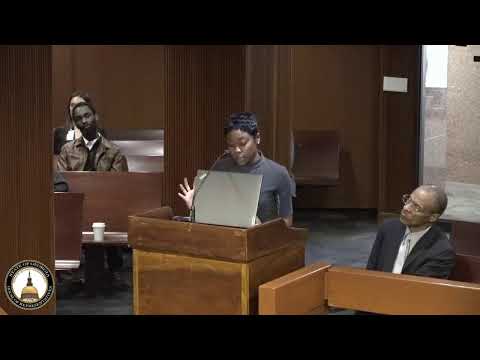
Deandre Berry, speaking for GPDC operations, provided operational figures: for FY25 the council reported about 8,716 contractor-handled cases and around 15,800 conflict cases overall; GPDC contracts with approximately 125 contractor attorneys. Berry said the conflict rate was roughly 12% at the end of calendar 2025 and that contractor caseloads averaged about 126 cases per contractor.
GPDC and local circuit public defenders described the dynamics driving costs: a surge of multi-defendant indictments (including RICO/gang cases) and jail-based altercations that produced groups of co-defendants. "Sometimes we have on one indictment 159 defendants," GPDC leadership said, explaining that such indictments can require many conflict-free outside attorneys and spike contractor spending. Circuit public defenders from DeKalb and Coweta counties described difficulty recruiting and retaining attorneys when county-paid positions pay substantially more than state-paid positions, and urged parity to improve staffing and caseflow.
Committee members repeatedly asked for more granular data — which jurisdictions see the multi-defendant cases, how often very large indictments occur, and a clear accounting of how ARPA funds were used in FY24 and FY25 — before agreeing to ongoing state support. Representative members expressed concern about treating a one-time federal ARPA infusion as a permanent funding source. GPDC staff said they would provide a jurisdictional breakdown and more precise spending confirmation at the committee's request.
GPDC also described the Ladders program, a statewide social-services and reentry-support initiative for youth ages 16–24 led by the council's social services team. Kenya Holmes outlined Ladders' goals of education attainment, employment support and reduced recidivism as a supplement to courtroom representation.
No formal appropriation vote was taken at the hearing; the committee asked GPDC and budget staff to return with clarified numbers and jurisdictional breakdowns before the next appropriations action.