
Homeland Security secretary highlights $9 billion Miami modernization and $1.1 billion in new TSA tech spending
Get AI-powered insights, summaries, and transcripts
Subscribe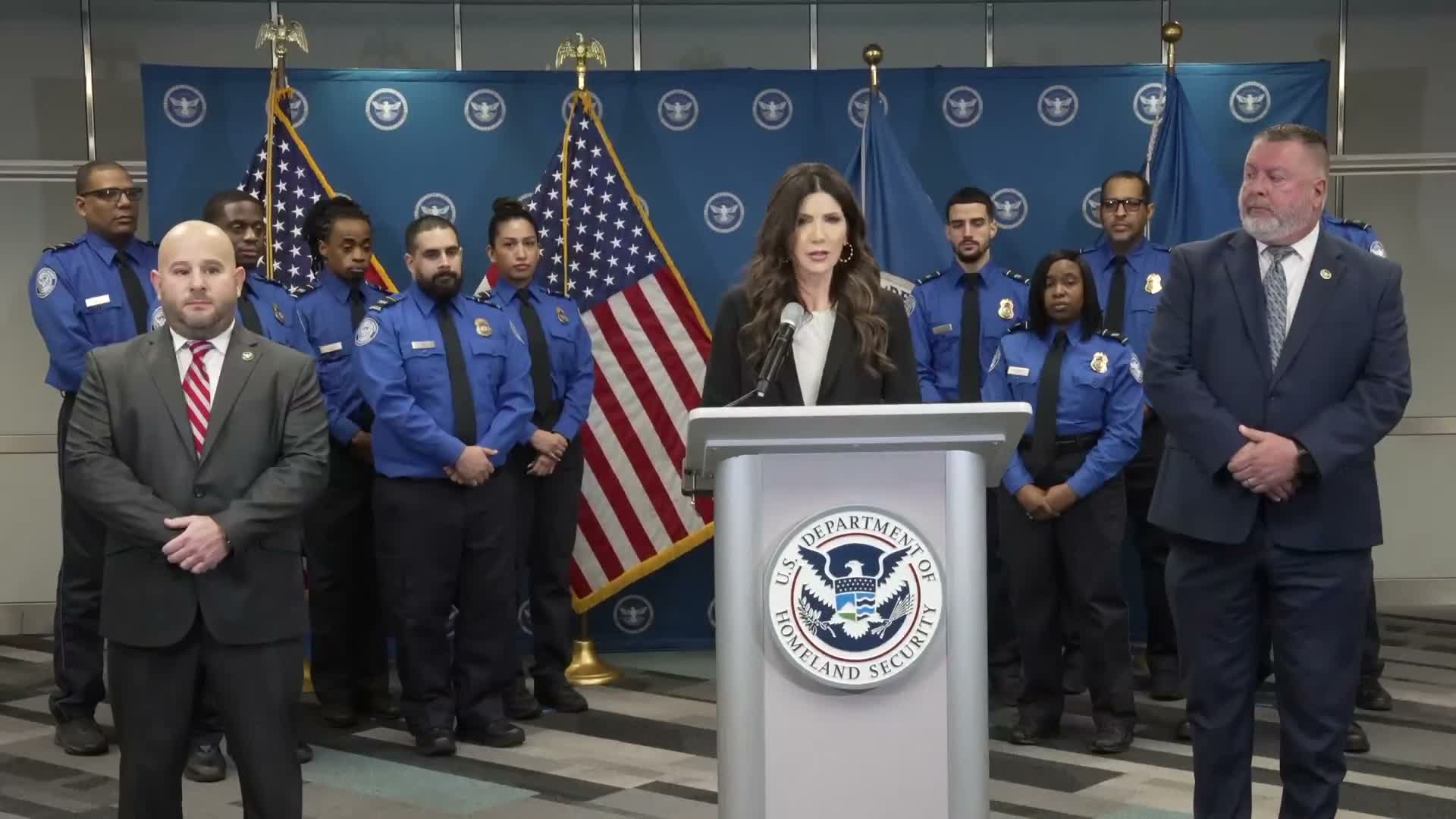
Summary
Secretary Kristi Noem visited Miami International Airport to announce a $9 billion airport modernization plan and said DHS/TSA will invest $100 million locally plus $1 billion in nationwide technology upgrades, including CT scanners, biometric gates and increased canine teams.
Secretary Kristi Noem visited Miami International Airport on Jan. 4 to outline a large-scale modernization plan for the airport and new national technology spending by the Transportation Security Administration.
Noem said Miami is part of a broader effort that includes a $9 billion modernization plan for the airport and that the TSA is contributing $100 million to local investments while DHS/TSA recently announced an additional $1 billion in technology upgrades for airports nationwide. "They're now undertaking a $9,000,000,000 modernization plan," Noem said, adding that the TSA "is putting a $100,000,000 into that investment" and that DHS had "also announced that we will be spending another $1,000,000,000 in technology upgrades across the country."
Why it matters: The upgrades are being positioned as preparations for major international events, including the FIFA World Cup and the Olympics, which Noem said will bring large numbers of international travelers and require heightened screening capacity and faster passenger processing.
Details and operations: Noem described a range of specific investments and operational changes the TSA has deployed or plans to deploy, saying the agency will increase canine presence, expand computed tomography (CT) and enhanced imaging technology, and roll out biometric gates and a touchless TSA PreCheck ID system. She cited Concourse D at Miami International Airport as an example of local improvements that have increased throughput, saying it is "allowing passengers to get screened over 30% faster." She also described automated bin return systems (quoted as "500 different bins per hour"), cross-screening lanes and bulk-resolution technology intended to speed passenger flow.
Noem attributed several operational outcomes to the strengthened security posture at Miami, noting the local workforce of "over 1,700 TSA employees" and reporting that the airport averaged about 70,000 passengers per day and experienced a screening peak close to 100,000 people on Jan. 4, 2026. The secretary framed the investments as measures to keep travel both secure and more hospitable for families and international visitors.
Attribution and verification: The investment figures and operational statistics cited here are from Noem's public remarks at the event. Some figures (for example, interdiction and screening totals cited by Noem) were presented without documentary evidence at the event and are therefore reported here as statements made by the secretary.
Next steps: Noem said the upgrades will be rolled out at the busiest airports nationwide. The event closed with the secretary thanking TSA staff and local partners.