Get Full Government Meeting Transcripts, Videos, & Alerts Forever!
Get email alerts on the Special Use Drive Thru topic
No spam. Unsubscribe anytime.
Bismarck planners conditionally approve drive‑through after debate over stacking space and easement
Summary
After a heated public hearing, the Bismarck Planning and Zoning Commission approved a special‑use permit for a drive‑through at Wachter's 17th with a condition that the city's staff review and approve the neighbor easement to ensure the required vehicle stacking is secure and enforceable.
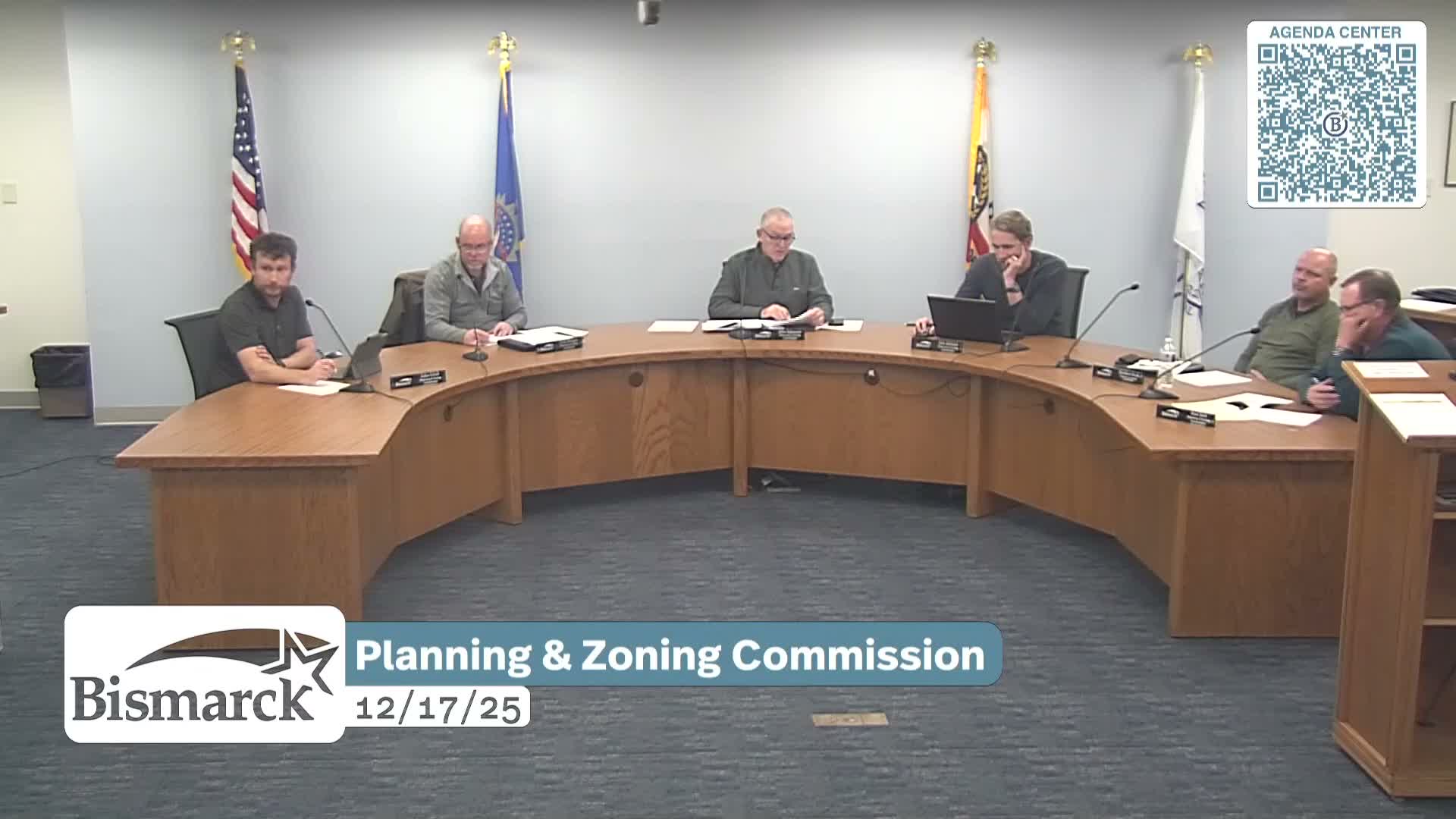
The Bismarck Planning and Zoning Commission voted Dec. 17 to approve, with conditions, a special‑use permit for a drive‑through at Lot 1, Block 2 of Wachter's 17th edition.
Staff presented a revised site survey showing the required vehicle stacking lane along the east side of the building measured 9.3 feet in some locations—short of the 10‑foot width and stacking-length standards in the ordinance—and recommended continuing the item so the applicant could submit a revised exhibit. Lauren, a city planner, told commissioners the ordinance requires vehicle stacking lanes to be "located completely upon the parcel of land that includes the structure they are intended to serve," and that the submitted survey meant the application did not meet requirement 3 in the staff report.
Applicant Kevin Kavanaugh told the commission he had secured a one‑foot easement from an adjacent property owner that, he said, would provide the extra width and allow construction to proceed. "I barely got it signed this afternoon," Kavanaugh said, and asked the commission for approval so he could move forward with loan payments and construction. He told commissioners, "I have 10 full‑size stacking lanes well before the building," and argued the proposed use met the ordinance's intent and would not place vehicles in the roadway.
City staff and the city attorney, Daniel, explained that an easement that lies off the parcel may not satisfy the ordinance language requiring stacking to be entirely on the parcel itself; possible remedies included a lot‑line adjustment or reconfiguring the drive lane so stacking occurred fully on the subject parcel. Daniel told the commission that any approval could be conditioned on staff verification of required documents and on the special‑use permit not taking effect until those conditions were met.
Commissioners debated whether an easement recorded against the neighboring parcel would be durable enough (for example, whether it would be recorded and whether an easement would prevent a future owner from erecting a fence). Some commissioners said they were sympathetic to the applicant's time pressures; others said they needed staff time to review the easement and any site‑plan revisions.
Commissioner Johnson moved to approve the special‑use permit with the condition that the easement be reviewed and approved by the city to ensure it provides adequate and lasting access in the spirit of a shared‑use or parking agreement; Commissioner Buettner seconded. The motion passed on a roll call vote with all commissioners present voting "yes." The approval was conditioned on staff acceptance of the easement terms and any required site‑plan revisions before the permit becomes effective.
The commission noted that separate site‑plan and building‑permit reviews remain required and that staff will verify the easement is recorded and durable enough to protect stacking space if property ownership changes. The applicant may return to staff with revised exhibits or pursue a lot‑line adjustment as an alternative remedy.
The Planning and Zoning Commission's conditional approval concludes the Commission's role for the special‑use permit; the applicant still must satisfy staff conditions before taking action under the permit.